


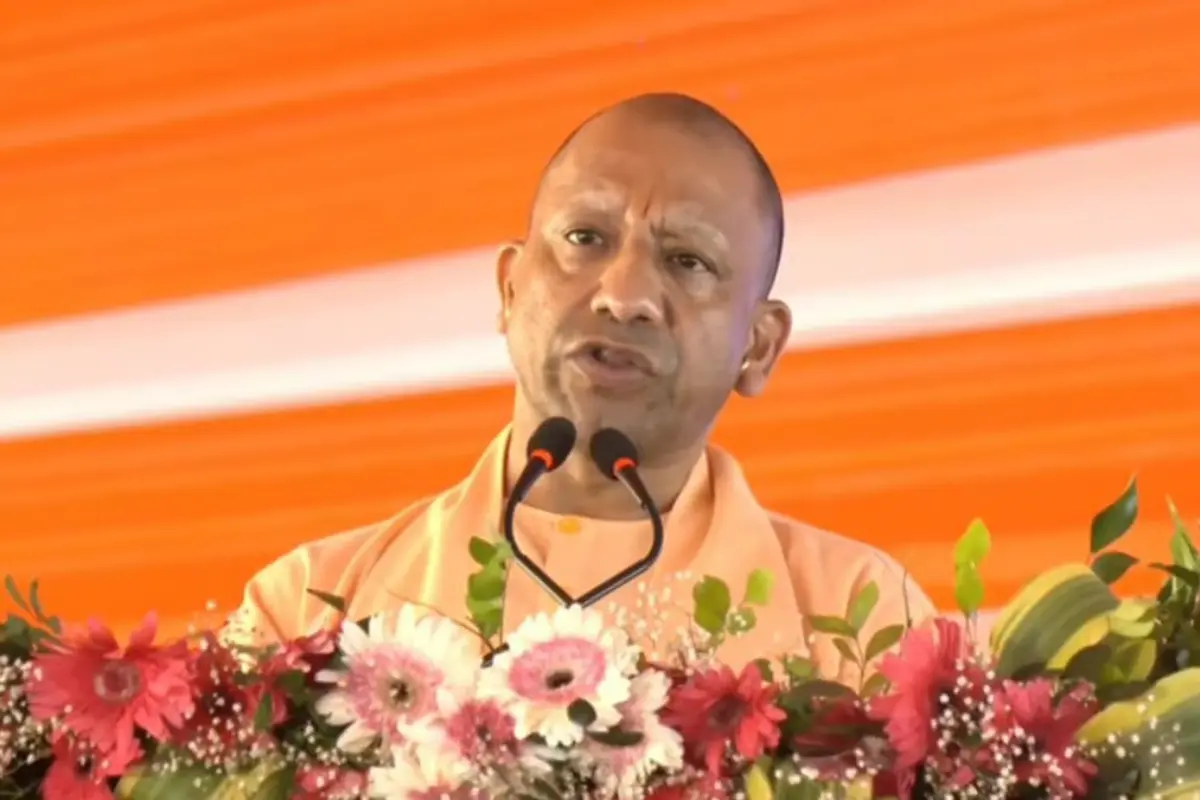
Chief Minister Yogi Adityanath described the Kashi Tamil Sangamam being held during the auspicious month of Kartik in Kashi, the sacred city of Lord Shiva, the seat of bliss, knowledge, and liberation, revered as Anand Kanan and Avimukt Kshetra, as a powerful step that strengthens and enlivens the spirit of Ek Bharat–Shreshtha Bharat.
Speaking at the inaugural ceremony in Varanasi on Tuesday, the Chief Minister said, “I am pleased that, inspired by Prime Minister Modi, the Uttar Pradesh government has introduced languages such as Tamil, Kannada, Malayalam, Telugu, Marathi, and Bengali into vocational education. Students may choose any language based on their interest, and the government will bear the full cost. Tamil, in particular, is opening new avenues in this direction.”
He noted that every year, large numbers of devotees from Uttar Pradesh travel to Rameswaram, Madurai, and Kanyakumari. To support this spiritual journey, the Tourism Department will soon launch special travel programs offering subsidized access to these pilgrimage sites. “This initiative,” he said, “is an investment in India’s future.”
Under the guidance of Prime Minister Modi, the Kashi Tamil Sangamam has emerged as a symbol of India’s cultural renaissance. The Chief Minister invoked the blessings of Lord Vishwanath, Mata Vishalakshi, Mata Annapurna, Mata Meenakshi, Ramanathaswamy, and the holy rivers Ganga and Kaveri for the success of the program.
Welcoming all guests in Tamil with the chants of Vanakkam Kashi and Har Har Mahadev, Chief Minister Yogi Adityanath expressed gratitude on behalf of the Uttar Pradesh government and its people. He said, “The fourth edition of the Kashi Tamil Sangamam, guided by the vision of Prime Minister Narendra Modi, is further strengthening the commitment to ‘Ek Bharat–Shreshtha Bharat’.
He highlighted that Lord Shiva lies at the heart of the ancient bond between Kashi and Tamil tradition, a relationship deepened by Adi Shankaracharya through the establishment of sacred Peethas in all four directions of the country.
The Chief Minister added that this visit to Uttar Pradesh offers a rare spiritual opportunity: after experiencing the devotion of Kashi, the confluence of Prayagraj, and the Dharmadhwaja in Ayodhya, visitors will also have the privilege of witnessing the divine presence of Lord Shri Ram. He emphasized that the event is enhancing cultural, educational, economic, and spiritual ties between North and South India, opening new pathways to India’s bright future.
This year’s theme, Let’s Learn Tamil, he said, is truly inspirational and will deepen national unity through knowledge, culture, and language.
Referring to the car rally that began from Tenkasi in Tamil Nadu, the Chief Minister described it as a major attraction of this year’s celebrations. The 2,000-kilometre journey, he said, is a reminder of the deep historical connection with the sacred land of Kashi. He mentioned the great Pandya ruler Adiveer Parakrama Pandian and noted that this journey echoes his ancient route toward the north. The story of the Shiva temple at Tenkasi, he said, occupies an important place in Tamil and Indian cultural heritage.
The Chief Minister added that this entire campaign, guided by Prime Minister Modi, will elevate knowledge, spiritual practice, cultural unity, and India’s shared civilizational heritage to new heights. It strengthens pilgrimage traditions, emotional ties, and historical as well as contemporary bonds.
Quoting the Sanskrit verse, “Ayodhya Mathura Maya Kashi Kanchi Avantika, Puri Dwaravati chaiva, saptaita mokshadayikah”, he described the sacred significance of India’s seven holy cities.
Referring to the Aditya Hridaya Stotra composed by Maharishi Agastya, he recalled how the sage recited it to Lord Rama before the battle against Ravana. He emphasized that South India has given India towering personalities such as Maharishi Agastya, Adi Guru Shankaracharya, Saint Thiruvalluvar, Jagadguru Ramanujacharya, and Dr. Sarvepalli Radhakrishnan, luminaries who illuminated the entire nation with knowledge.
He said that the Shaiva and Vaishnava traditions reflect the spiritual richness of Tamil civilization. The Chettiar community, he noted, has supplied worship materials to the Kashi Vishwanath Temple for the last 200 years. The tradition of offering water from the Triveni Sangam to Rameswaram’s Sri Ramanathaswamy Temple, and bringing water from Koditheertham for the Kashi Vishwanath Temple, now continues every month, symbolizing an unbroken spiritual connection between the two regions.
Chief Minister Yogi Adityanath said that the presence of Tamil culture remains vibrant in Kashi, especially along Kedar Ghat, Hanuman Ghat, and Harishchandra Ghat. He described the joint educational initiatives between IIT Madras and BHU as an inspiring step towards national unity.
The Chief Minister added that during their visit, participants will also travel to Prayagraj and Ayodhya. A temple dedicated to Maharishi Agastya has been constructed within the Shri Ram Janmabhoomi complex in Ayodhya, where a magnificent statue of the revered sage has also been installed. The entrances of the Shri Ram Temple have been named in honour of Jagadguru Shankaracharya and Jagadguru Ramanujacharya, while statues of South Indian saints, Tyagaraja, Purandara Dasa, and Arunachala Kavi, have been placed at Brihaspati Kund in Ayodhya.
He further said that the construction of the Kashi Vishwanath Dham, led by Prime Minister Modi, has revitalized India’s cultural and spiritual consciousness. More than 26 crore devotees have visited the temple in the last four years, with the highest footfall coming from Tamil Nadu.
At the event, Vice President C.P. Radhakrishnan virtually delivered a message on the fourth edition of the Kashi Tamil Sangamam. He said that the festival, which began in 2022 during the Azadi Ka Amrit Mahotsav, has now evolved into a major national cultural platform.
The Sangamam, he said, symbolizes the unity of North and South India, bridging the heritage of the Ganga and the Kaveri. He recalled Prime Minister Modi’s recent Mann Ki Baat reference that this confluence represents the meeting of one of the world’s oldest languages with the world’s oldest living city.
DON'T MISS
Expressing satisfaction that Tamil is receiving well-deserved national recognition, the Vice President said that this year’s theme, “Let’s Learn Tamil,” promotes linguistic and cultural harmony. He praised the initiative of 50 Hindi-speaking teachers who have come to teach Tamil, training 1,500 students in 50 schools across Varanasi.
He also highlighted the Agathiyar Yatra from Tenkasi to Kashi as a meaningful effort to revive cultural bonds. Welcoming the educational tour of 300 students from Uttar Pradesh to premier institutions in Tamil Nadu, he said such exchanges will deepen cultural understanding. Calling the Sangamam a living embodiment of Ek Bharat Shreshtha Bharat, he wished for its continued success and for the eternal strengthening of Kashi–Tamil cultural ties.
Union Education Minister Dharmendra Pradhan said that Kashi is a land of sanctity, knowledge, and spirituality, and that Tamil and Kashi cultures have shared a deep connection for centuries. He noted that in many temples across Tamil Nadu, the idol of Kashi Vishwanath Mahadev is prominently installed, reflecting this ancient bond. Just as South India reveres Rameswaram, he said, people hold equal devotion for Kashi Vishwanath, an enduring hallmark of India’s civilizational unity.
He highlighted how, in 2022, under Prime Minister Modi’s leadership, a cultural bridge was built between Uttar Pradesh and Tamil Nadu that is proving transformative not only for intellectual exchange but for national integration. During the exhibition tour, when the Chief Minister used an AI tool, a Tamil exhibitor spoke in Tamil, and the tool instantly translated the message, an innovation the Minister praised.
Referring to the Mahakumbh, he commended the Uttar Pradesh government’s preparations and acknowledged that the Kashi–Tamil Sangamam has now grown into a mass movement. He urged the Chief Minister of Tamil Nadu to rise above ideological differences and participate in the festival.
The Union Minister said that India’s cultural and linguistic diversity is its greatest strength. He appreciated the BHU–IIT Madras collaboration, the contributions of Tamil teachers and students, and the significance of the Kashi–Tamil car rally. Citing Maharishi Agastya, he called for unity and for moving beyond colonial mindsets to embrace India’s shared civilizational heritage.
Chief Minister Yogi Adityanath joined a group photograph during the inaugural ceremony of the fourth edition of the Kashi Tamil Sangamam in Varanasi. He visited the exhibition area and reviewed various stalls set up for the event.
At the main ceremony, guests were welcomed with the blowing of conch shells and the chanting of Swasti. Chief Minister Yogi Adityanath and Union Education Minister Dharmendra Pradhan felicitated Vedamurti Devvrat Rekhe and Balaji Balu Haridoss with robes and mementoes. A short film was also screened on the occasion.
This year’s theme, “Tamil Karkala”, meaning “Let’s Learn Tamil”, was highlighted through several initiatives. To promote the learning of Tamil, the Chief Minister released translated editions of the Tamil grammatical classic Tolkappiyam in 13 languages. Guests also enjoyed traditional Tamil folk dances and cultural performances, including a dance presentation set to the Kalabhairavashtakam, with many seen softly singing along to “Kashikapuradhinatha Kalabhairavam Bhaje.”
The event was attended by Tamil Nadu Governor R.N. Ravi, Union Minister of State for Information and Broadcasting Dr. L. Murugan, Puducherry Lieutenant Governor K. Kailasanathan, Deputy Chief Minister Brajesh Pathak, Labour and Employment Minister Anil Rajbhar, Minister of State for Stamps and Registration (Independent Charge) Ravindra Jaiswal, AYUSH Minister Dayashankar Mishra ‘Dayalu’, Union Higher Education Secretary Dr. Vineet Joshi, BHU Vice-Chancellor Prof. Ajit Chaturvedi, IIT Madras Director Prof. V. Kamakoti, IIT BHU Director Dr. Amit Patra, along with several other dignitaries.