


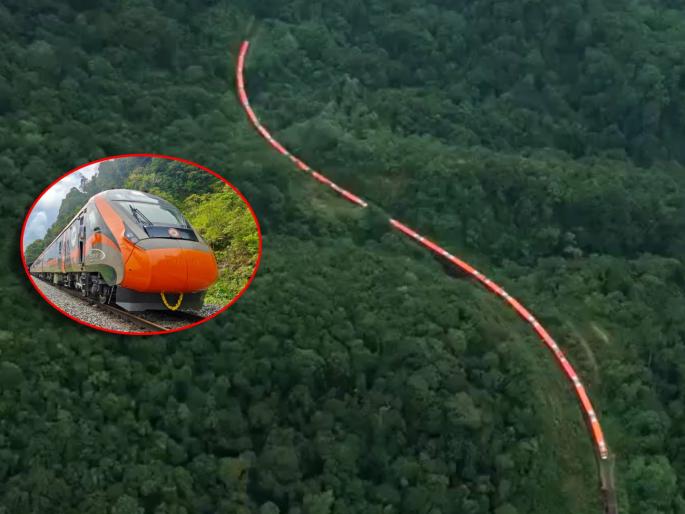
A specially modified Vande Bharat Express has recently attracted attention after completing a trial run through the challenging Western Ghats in Karnataka. The striking orange-and-white train was seen winding through tunnels, bridges and sharp curves, earning it the popular nickname “Orange Snake of India.”
DON'T MISS
The trial is significant because the route presents several operational challenges for a modern semi-high-speed train. Indian Railways is testing the train’s braking, speed control and handling capabilities before any decision on regular passenger operations.
Vande Bharat Trial Run Through the Western Ghats
The trial was conducted on the Bengaluru–Mangaluru railway route, particularly the difficult Sakleshpur–Subrahmanya Road ghat section.
This approximately 55-km stretch passes through a demanding mountainous landscape featuring around 57 tunnels, more than 200 bridges and about 108 sharp curves. The route also has steep gradients, making speed and braking control especially important.
The specially prepared Vande Bharat rake was brought from the Integral Coach Factory (ICF), Chennai, for technical trials in Karnataka.
Why Is It Called the “Orange Snake”?
The nickname is inspired by the train’s appearance during the trial. As the long orange-and-white rake moved through the green Western Ghats, it appeared to wind through the hills like a snake.
However, “Orange Snake” is not the train’s official name. It is simply a popular description used for the visually striking train seen during the trial.
Special Safety System Added to the Train
One of the most important aspects of the trial is the use of an Automatic Emergency Brake (AEB) system.
The system is particularly relevant on the mountainous section, where steep gradients and curves require careful speed management. During the trial, the train’s speed on the difficult 55-km section was planned at around 30 kmph, with the braking system designed to help prevent excessive speed when required.