


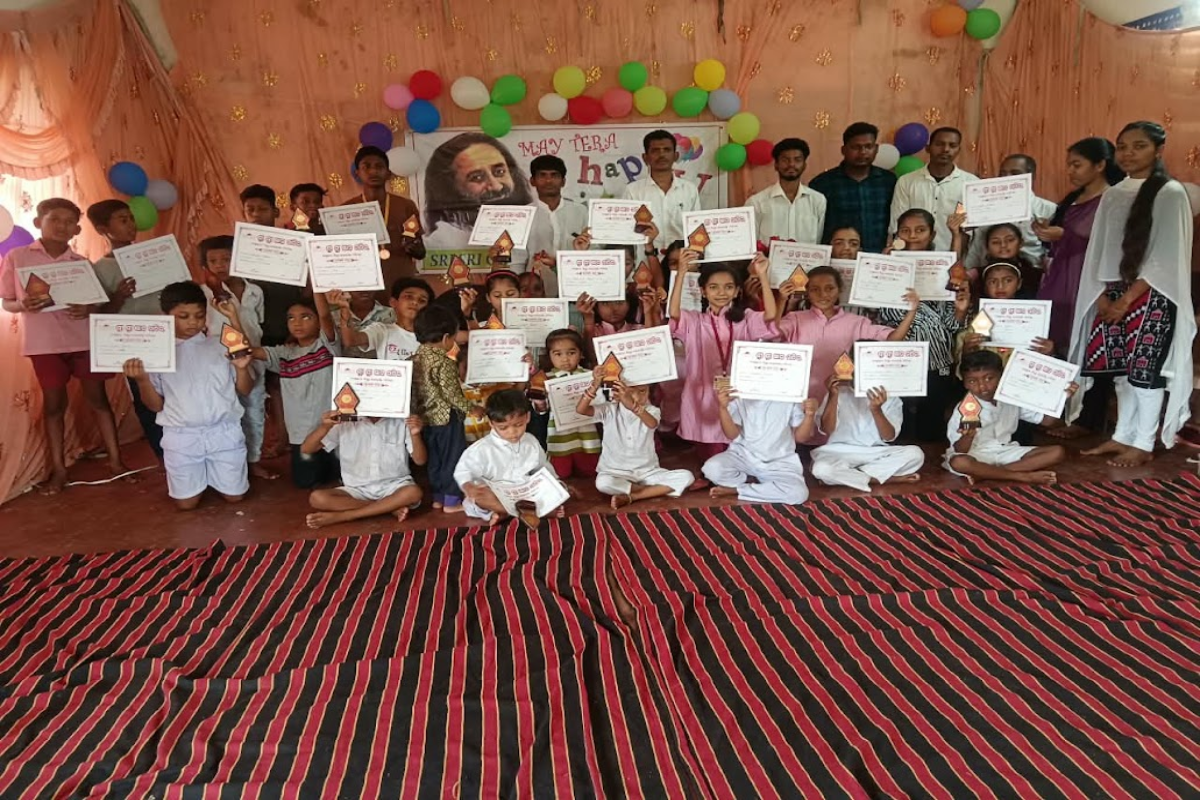
For 153 children in Kalahandi, where most families depend on daily wages, Sri Sri Gyaan Mandir is making an important promise- a child’s future need not be limited by the circumstances they are born into.
In a village in Odisha’s Kalahandi district, a district that remains in public memory for its severe socio-economic challenges, including years of drought and starvation, a classroom is quietly challenging an idea that many children grow up accepting as reality: that the opportunities available to them will always be determined by what their families can afford.
For children of daily-wage labourers, education can often mean a difficult choice for the household. When every day’s earnings go towards putting food on the table, the cost of schooling can become an additional burden. And when access to education is uncertain, so are the possibilities that come with it.
At Sri Sri Gyaan Mandir, however, 153 children are getting the opportunity to imagine a different future.
But what makes the school interesting is not simply that it brings education within reach. It is also about the kind of learning it seeks to nurture.
Badravan, an Odia and Mathematics teacher at a private school, has three daughters studying at Sri Sri Gyaan Mandir. All three have consistently secured the first positions in their respective classes- an achievement he attributes in part to the quality of education and the learning environment at the school.
“What I particularly appreciate is that there is no unnecessary pressure on the children. They get the opportunity to learn comfortably and develop at their own pace,” he says.
As an educator himself, Badravan is particularly appreciative of the school’s emphasis on meditation. He believes the practice helps his daughters remain calm, focused and peaceful -qualities that are just as important to their development as academic performance.
The only free school in the village, the institution provides education from Nursery to Class 8 without charging tuition fees. Nearly 70 per cent of its students come from labour-class families. For their parents, the school represents something more than an affordable education: the assurance that their children’s aspirations will not have to take a backseat to the family’s financial circumstances.
Supported by The Art of Living’s Free School initiative, the school has a teaching staff of 10 and enrols 57 girls. The initiative traces its beginnings to 1981, when Gurudev Sri Sri Ravi Shankar, the globally renowned humanitarian leader and founder of The Art of Living, noticed children of construction workers playing around the site where The Art of Living’s centre was being built, with no access to education. What began with an effort to reach these children has since grown into a network of more than 1,356 free schools, educating over 1.2 lakh children across 22 states and 2,032 villages in India. For Gurudev, this work reflects a conviction he has consistently championed: “Education is this civilization’s greatest leveler. It has the power to empower the weakest of the weak, bring peace to the world and alleviate poverty.”
DON'T MISS
There is another lesson the children are learning, one that does not appear on their report cards.
Students participate in village cleanliness drives and distribute pamphlets to spread awareness about hygiene and sanitation. In taking these small initiatives beyond their classrooms, they are discovering that education is not merely about securing a better future for oneself. It is also about contributing to the community one belongs to.
For a child growing up in a household dependent on daily wages, the idea of what is possible can sometimes be shaped by the limitations of the present. A school that removes the cost of education, encourages curiosity, builds confidence, and nurtures a sense of responsibility can begin to change that equation.
A school day here is not confined to lessons, homework, and examinations. Children begin with a routine that includes 15 minutes of meditation and another 15 minutes of spiritual knowledge and value-based learning. Ganesh, Guru, and Saraswati mantras are also part of their daily practice. The intention is to nurture qualities that are often overlooked in conventional measures of academic achievement- concentration, emotional balance, confidence, and discipline.
The school has computers to introduce children to digital learning, while two vans help facilitate their commute. Additional classes are conducted three days a week for students who need help with particular subjects. The emphasis is on ensuring that children are able to understand what they learn, without being overwhelmed by academic pressure.
At Sri Sri Gyaan Mandir, the transformation speaks through a child gaining confidence in the classroom, a parent finding reassurance in a daughter’s progress, or a student discovering that learning can extend far beyond the pages of a textbook.
There are 153 children here, each with a different story and a different possibility ahead. What unites them is the opportunity to pursue an education without their family’s income deciding how far they can go.