


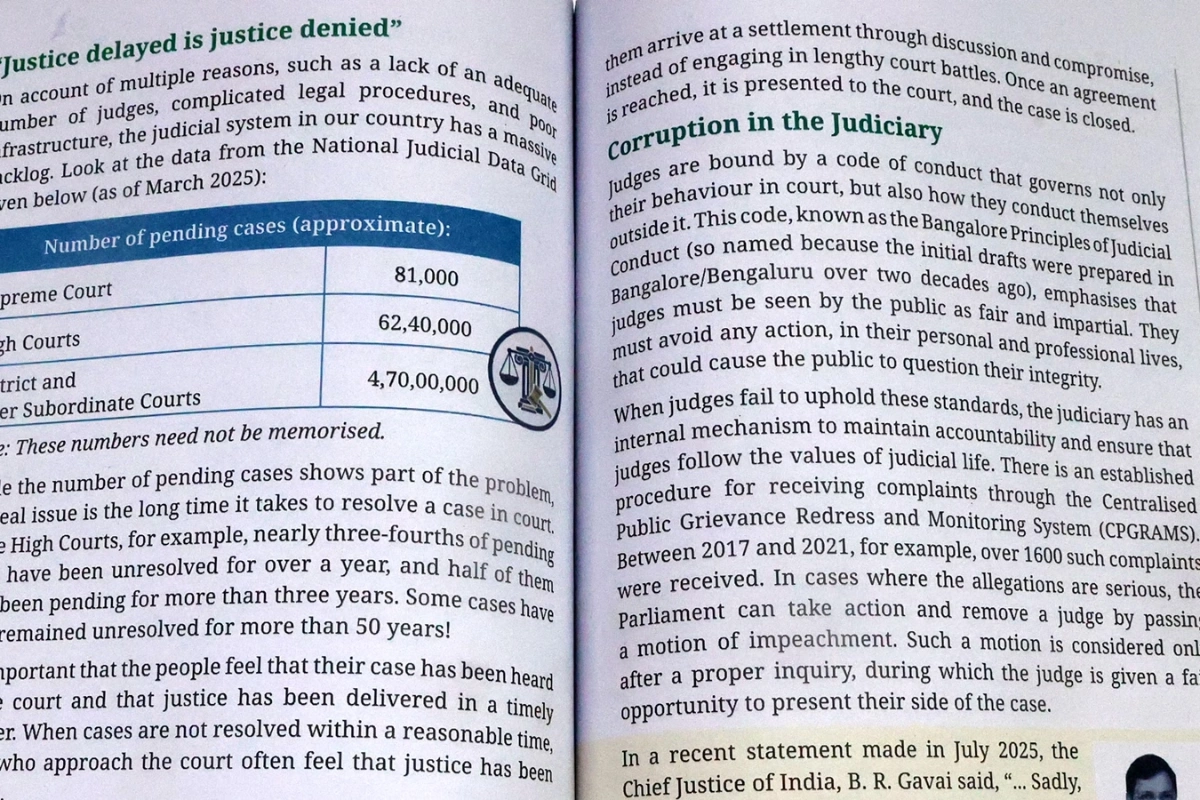
NCERT Textbook Controversy: The National Council of Educational Research & Training (NCERT) has issued an apology to the Supreme Court after it Chief Justice of India Surya Kant blasted NCERT over a chapter discussing backlogs and corruption within the Indian judiciary.
In reply, an unqualified and unconditional apology was rendered by Solicitor General Tushar Mehta on behalf of the Union Education Ministry.
NCERT Textbook Controversy
In a new textbook, a chapter titled “The Role of the Judiciary in Our Society” included references to an inadequate number of judges, a heavy backlog of cases and corruption.
NCERT Issues A Press Release
In a press release, NCERT said that it holds the judiciary in highest esteem and considers it to be the upholder of the Indian Constitution and protector of Fundamental Rights. The press release went on to state that NCERT regrets the inclusion of inappropriate material in the said chapter.
Furthermore, the NCERT press release stated that the objective of the new textbooks is to strengthen constitutional literacy, institutional respect and informed understanding of democratic participation amongst students. It also said that there is absolutely no intent to question or diminish the authority of any constitutional body.
NCERT added that the same shall be re-written, with consultation of the appropriate authority, as necessary, and would be made available to students of Class 8 accordingly on the commencement of academic session 2026-27.
DON'T MISS
Senior Advocate Vikas Singh, the President of Supreme Court Bar Association, remarked that the issue of Class 8 students being taught ‘corruption in the Indian judiciary’ is shocking. Singh asked if there is a sub-chapter with regard to the 40 percent of all MLAs and MPs who have a serious criminal background.
Noted activist and lawyer Prashant Bhushan has blasted the actions of the Supreme Court of India. Bhushan said it’s unfortunate that the Supreme Court and some senior lawyers took umbrage at the new chapter in the NCERT text book about the Judiciary and that corruption is one of the challenges it faces. Bhushan went on to say that considerable corruption in the judiciary is seen and perceived acutely by litigants.


 has issued an apology to the Supreme Court.)