


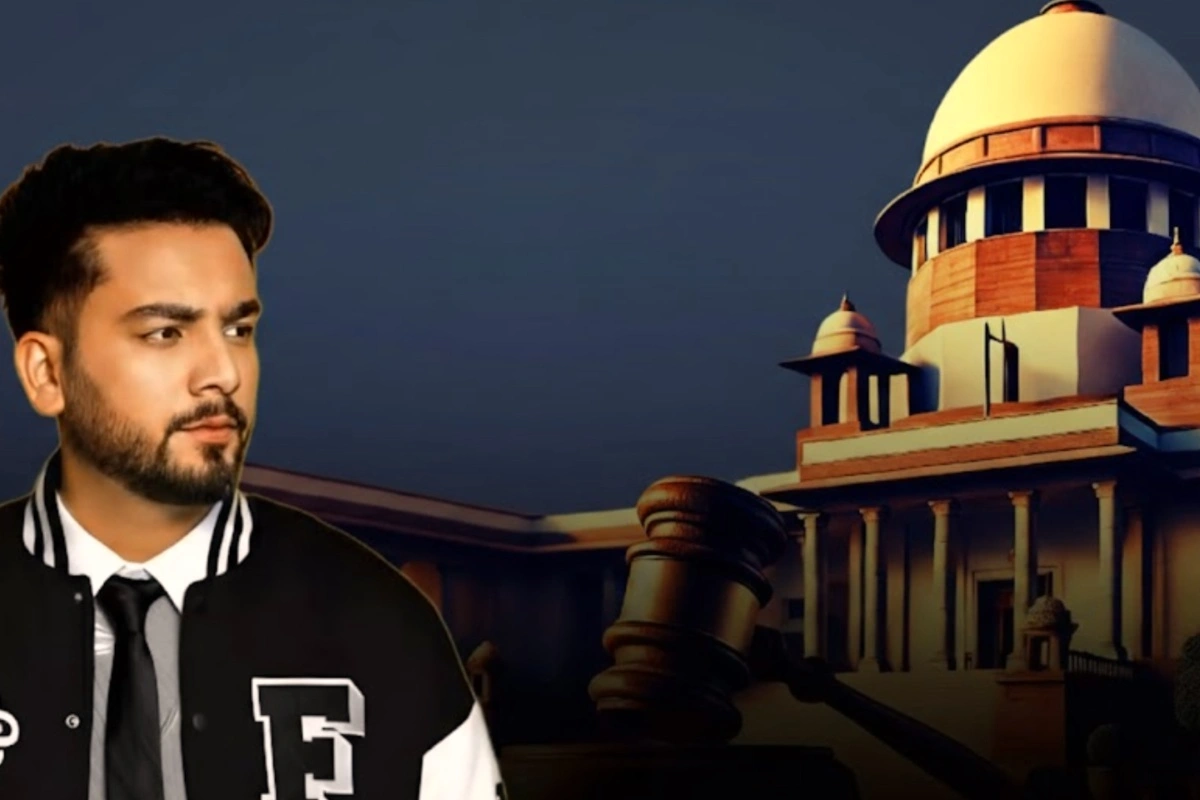
The Supreme Court made sharp observations on Thursday while hearing the case involving popular Bigg Boss OTT 2 winner and YouTuber Elvish Yadav. The case centres on allegations of misuse of snakes and snake venom during a video shoot. The bench stressed that wildlife protection laws are strict and must be followed without exception.
A bench of Justices MM Sundresh and N Kotiswar Singh questioned the Uttar Pradesh government about the permissions claimed by Yadav and his associates. The judges said their immediate concern was clear. They wanted to know whether any valid permission existed for using snakes and whether such approval could ever allow venom extraction.
The bench said, “We will send a very bad message outside if a person like you, who is otherwise popular, is allowed to use a hapless victim which is voiceless.”
The judges mentioned that the Wildlife (Protection) Act contains “very clear” rules designed to protect animals.
Supreme Court Questions Handling Of Snakes By Elvish Yadav
During the hearing, the bench directly addressed Yadav’s legal team. The judges asked whether Yadav had handled the snake. They also compared the situation to interacting with animals in protected spaces.
The bench told Yadav’s counsel, “Did you deal with the snake or not? Can you go to the zoo and play with animals there? Will it not be an offence? You cannot say that you will do whatever you want.”
Court further explained that even if someone spots a snake nearby, the law requires them to inform wildlife officers instead of acting independently.
The court asked, “The only question in our mind is about the snake. The rules there are very clear. Even if you spot a snake near you, you cannot kill it. You have to inform the wildlife officers. So, how come you had snakes?”
DON'T MISS
Senior advocate Mukta Gupta, appearing for Yadav, argued that permissions had been obtained for the video. However, the bench raised doubts about that claim.
“Can there be a permission for a video? And what about venom? Even if you had permission for a video, can you extract venom? We do not think that can ever be allowed.”
Elvish Yadav’s Defence Challenges Legal Grounds
Mukta Gupta presented four main arguments on behalf of Yadav. First, she cited Section 55 of the Wildlife (Protection) Act. She argued that courts cannot take cognisance of offences based only on police reports. According to her, proceedings must begin through a complaint filed by a competent authority such as the Director of Wildlife Preservation or the Chief Wildlife Warden.
Second, she challenged the application of the NDPS Act. Gupta stated that no scheduled narcotic substance had been recovered. Gupta argued, “There is no recovery from me. No possession. No consumption. No link.”
She added that the NDPS charges relied on only 20 ml of liquid and a report mentioning antibodies, not venom. She told the court, “Criminal law cannot be expanded by investigative imagination.”
Third, Gupta referred to a related case filed in Gurugram, which resulted in a closure report. Fourth, she questioned the criminal conspiracy charge under Section 120B of the Indian Penal Code, calling the allegation “preposterous”.
Claims Against Elvish Yadav Over Video Shoot And Snakes
Addressing the factual allegations, Gupta denied that any rave party took place. She said there were no guests and no recovery linked to Elvish Yadav. She also clarified that the video mentioned in the charge sheet was allegedly from a song shoot by Faizal Puriya. According to Gupta, Yadav made only a guest appearance after “proper permissions”. She added that the snakes were healthy and later released.
Furthermore, Gupta argued that medical reports found the nine examined snakes to be non-poisonous.
At this stage, counsel for Uttar Pradesh sought time to verify the permissions claimed by Yadav’s side. The Supreme Court granted time and directed the state to examine the validity and scope of those permissions.
The matter has now been posted for March 19, 2026. The state is expected to submit additional material on record at the next hearing.