

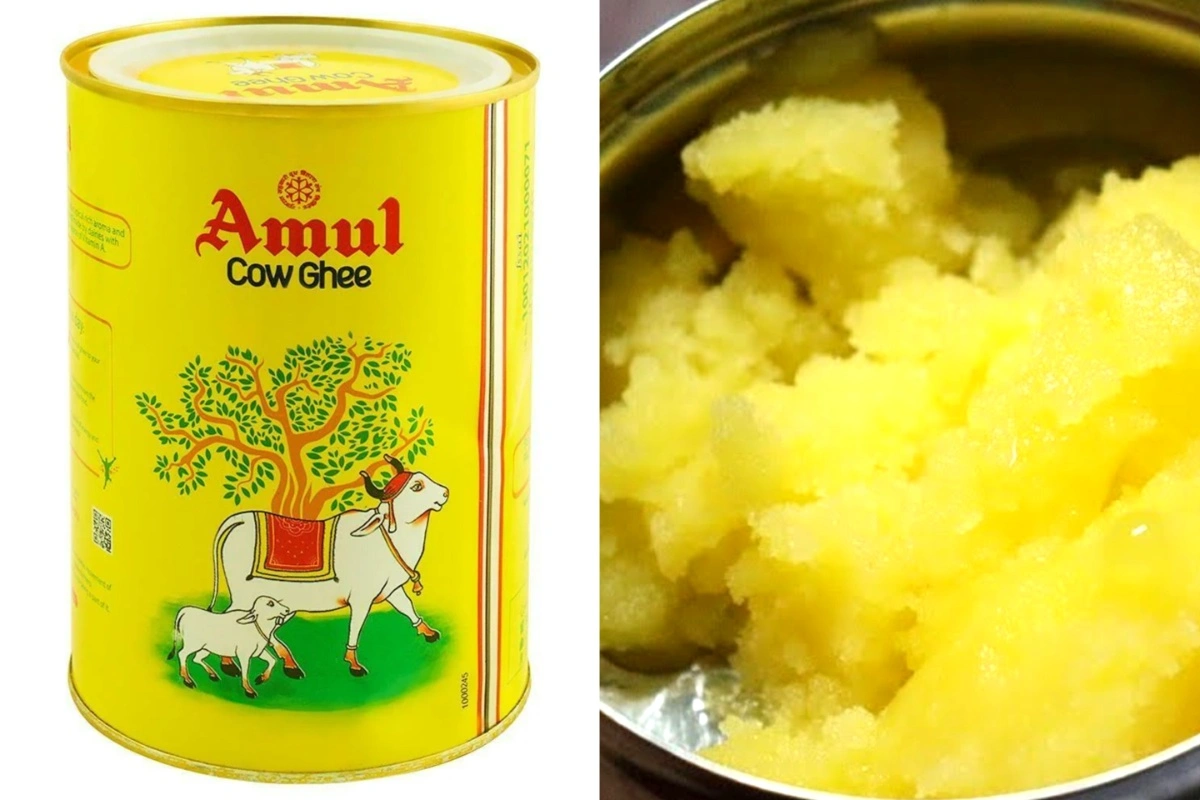
Ghee Test: If you use ghee every day, this report may change the way you look at your favourite brand. A new blind test on Amul Cow Ghee showed almost perfect results in six major purity checks. But an unexpected chemical showed up in the final stage, and that changed everything. Here’s the complete breakdown in simple language.
This test was carried out by Trustified, India’s first and only 100% blind testing certification programme. A month ago, they ran a poll asking viewers which ghee brand they should test next. Amul Cow Ghee got the highest votes.
Trustified studies research papers before entering any new product category. For honey, they discovered that the best method was NMR testing. For ghee, they first identified all parameters required to detect adulteration and contamination.
Ghee Test: Amul Cow Ghee Gives Shocking Results
To keep the process fair, Trustified ordered two 500g pouches of Amul Cow Ghee from Zepto. Both packs were from the same sealed batch. One was sent directly to the lab for blind testing. The other stayed with the team for reference. They even recorded an uncut unboxing video to show that the product went straight from delivery to the lab without any interference.
Macro Accuracy – Passed
Pure ghee should contain only fat. It should not have protein, carbohydrates or sugar.
The lab results showed:
Protein: Not detected
Carbohydrates: Not detected
Sugar: Not detected
Fat: 99.91%
This confirms that the sample met the basic purity requirement.
DON'T MISS
Adulteration Test – Passed
To check for adulteration with vegetable oils like palm oil or hydrogenated oil, the lab tested for Beta-Sitosterol.
Result: Beta-Sitosterol was absent, meaning the fat is genuine cow milk fat.
Refractive Index & Fatty Acid Profile – Passed
The refractive index matched the FSSAI standard for pure ghee. The fatty acid profile also aligned with the expected composition of natural cow ghee. No trans fats were detected.
Heavy Metals & Aflatoxins – Passed
All heavy metals came back below detectable limits. All aflatoxins were also below detectable levels. Until this point, the product had passed every test smoothly.
Pesticide Test – Failed
This is where the surprise appeared. One pesticide, Novalon, was detected at 0.014 mg/kg.
The safe limit (MRL) is 0.01 mg/kg.
This means it exceeded the limit by 40 percent. Even though the number looks small, FSSAI rules are clear: pesticide levels must not cross the Maximum Residue Limit. Pesticides are harmful even in small excess, so exceeding the limit is considered unsafe.
Because of this single parameter, the sample failed Level 7.
What Does The Test Conclude?
Amul Cow Ghee passed:
– Macro purity
– No vegetable oil adulteration
– Correct refractive index
– Perfect fatty acid profile
– Heavy metals test
– Aflatoxins test
But it failed the pesticide test due to Novalon crossing the allowed limit.
The ghee was almost perfect, yet one unsafe chemical changed the entire result. This is why independent blind testing matters. Even trusted brands can have hidden issues.