


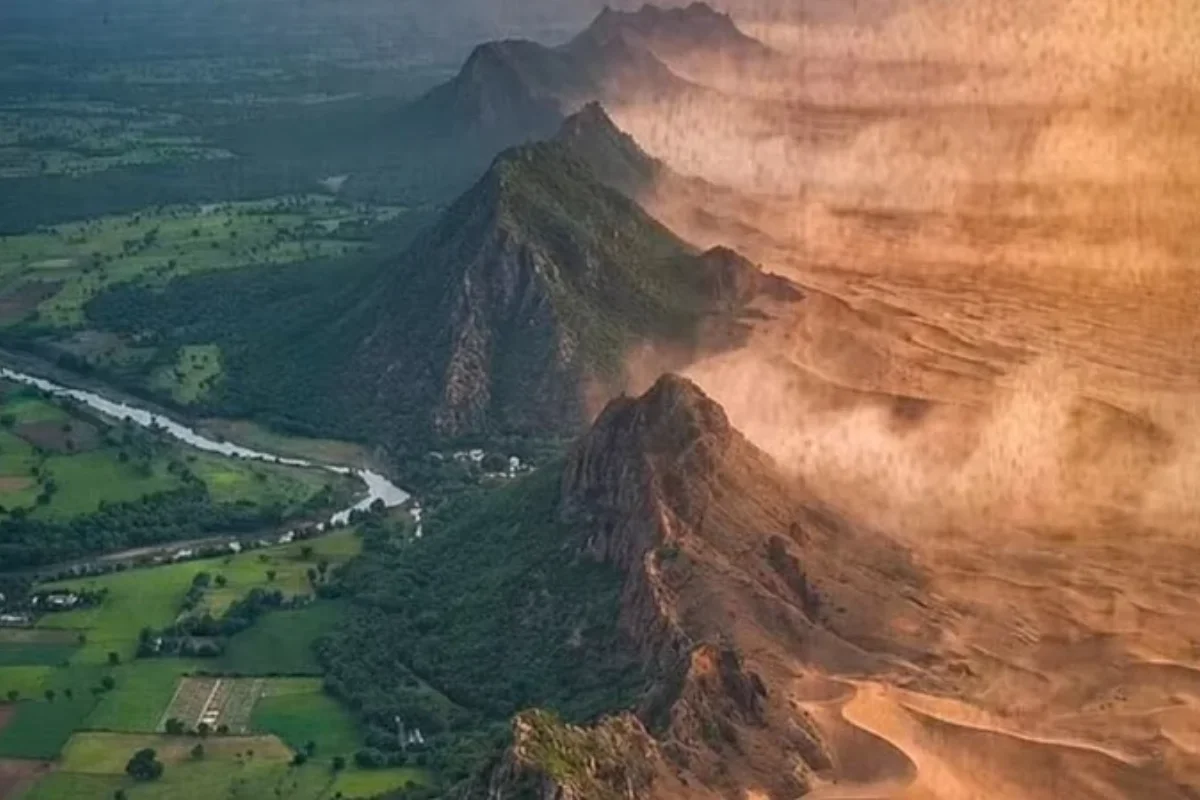
Aravali Hills: The recent order by Supreme Court (SC) of India introducing a new legal definition of what qualifies as the Aravalli range has turned into a massive controversy.
Rajasthan’s former chief minister Ashok Gehlot claimed that the report by the Union Government where it redefined the Aravali Hills would end up destroying 90 percent of the state’s mountain range.
What’s The New Definition Of Aravali Hills?
According to the new definition, “Aravalli Hill is any landform in designated Aravalli districts with an elevation of 100 metres or more above its local relief” and an “Aravalli Range is a collection of two or more such hills within 500 metres of each other”.
On November 20 this year, the SC accepted the recommendations of a committee under the Ministry of Environment, Forests and Climate Change on the definition of Aravalli Hills and Ranges.
DON'T MISS
BJP’s Rebuttal
Senior BJP leader Rajendra Rathore rejected Gehlot’s claim and said the 100-metre criterion is not limited to height alone.
“According to the court-approved definition, all hills of 100 metres or more, their slopes, and terrain within 500 metres between two hills remain outside the mining ambit irrespective of height. This framework is stricter and more scientific than before,” he said at a press conference.
Rathore added the claims of Gehlot were “completely false and misleading.” He also remarked that only about 2.56 percent of the notified Aravalli region is under limited and strictly regulated mining and said approximately 25% of the Aravalli area falls under wildlife sanctuaries, national parks and reserved forests where mining is completely prohibited.
Rathore also said that 98.9% of hilly areas in Rajsamand, 99.89% in Udaipur, 89.4% in Gujarat’s Sabarkantha and 75.07% in Haryana’s Mahendragarh would remain prohibited for mining, apart from eco-sensitive zones, national parks, reserved and protected forests and wetlands.
Rathore added that Union Environment Minister Bhupender Yadav has already issued a clarification that the SC orders pose no threat to the Aravalli range. Yadav had said only mining activity in the Aravalli range will be allowed in only 0.19 per cent of the area, which is less than one percent, and even in that area, no new mines have been opened.
Rathore also added that it has already been clearly indicated by the Supreme Court of India that no mining leases can be issued till the Indian Council of Forestry Research and Education completes detailed scientific mapping and prepares a sustainable mining management plan.