


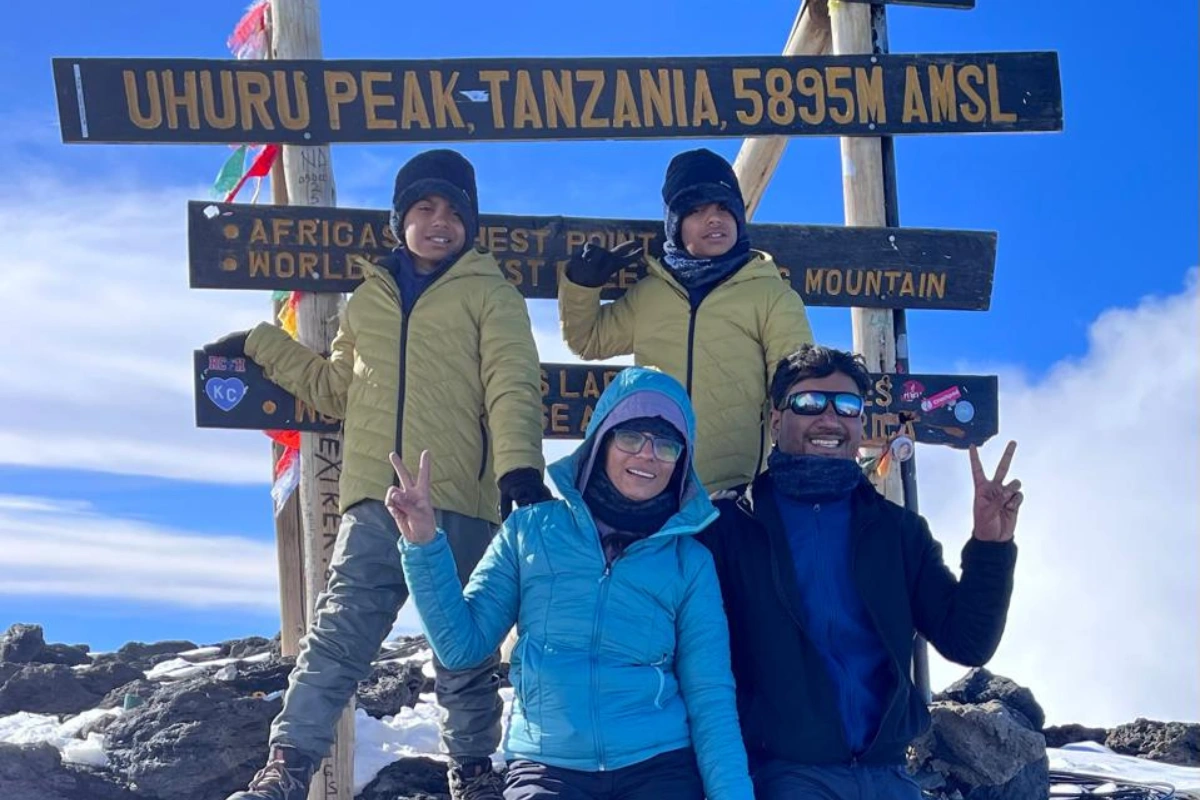
Mount Kilimanjaro: Age is merely a number when determination writes an unforgettable story and achievement. This was proved yet again when nine-year-old twins Samraat Singh and Vardaan Singh along with their parents (Anand Singh and Manmeet Singh) conquered Mount Kilimanjaro, the highest peak of Africa at 5,895 meters.
What’s Special About This Mount Kilimanjaro Conquest?
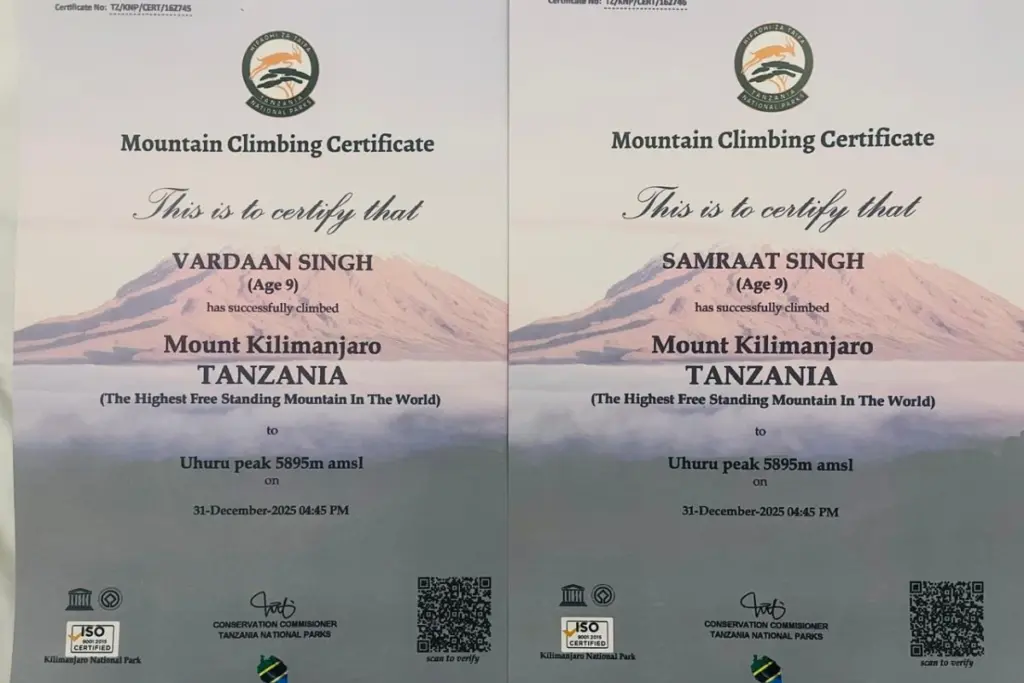
On the eventful evening of 31 December 2025 at 4:45 pm, Samraat and Vardaan were guided by their parents to the Mount Kilimanjaro summit. This extraordinary feat positions the twin brothers among the youngest twins ever to conquer the mountain. The feat surpassed the record set by American twins Alex and Alan Loynd at age 10.
Interestingly, Samraat and Vardaan had already conquered the Everest Base Camp (5,364 meters) in June 2024, shattering long-carried assumptions of the world about childhood capabilities.
What Makes The Mount Kilimanjaro Conquest Special?
Mount Kilimanjaro stands tall at 5,895 meters that makes it the highest peak of Africa. It is also the world’s tallest free-standing mountain, towering even higher about the altitude of the Everest Base Camp at 5,364 metres.
DON'T MISS
Near the summit, oxygen levels drop down to a staggering 50 percent of what is available at sea level. To make things worse, temperatures can plunge to between −15 and −25 °C. These extremely harsh weather conditions have resulted in the death of more than 200 people by now due to rock falls, altitude sickness and other life-endangering hazards. No wonder, the overall summit success rate is only approximately 65 percent, meaning about 35 percent of those who consider themselves fit either require evacuation, fall ill or simply give up.
What Makes Mount Kilimanjaro Difficult Than Everest Base Camp?
Compared to Everest Base Camp’s 14‑day itinerary, Mount Kilimanjaro is considered tougher among mountaineers across the world due to an especially demanding summit push and fewer acclimatization days.
The Singh family’s relentless pursuit and preparations reflected this harsh reality. All four of them trained hard for 3-4 months, building on their earlier Everest Base Camp experience.
On their final preparation day, the team of parents and their twin sons jogged 31 kilometers on their society ramp. They also climbed 10 towers within 12 hours, pushing their physical limits to simulate long, torturous days on the mountain. The team of parents and their twin sons also practiced exposure to severe cold by lying in a bathtub filled with ice for 30–40 minutes to prepare their bodies for temperatures close to −20 °C.
The actual trek was organized as a private expedition with a support team of 14 members, including a chef, a helper, two guides and porters carrying food for 7 days, tents, chairs, bags, mattresses, utensils, sleeping bags, gas cylinders and more. Everyone hiked 10-14 kilometers every day, often with wet shoes and clothes in continuous rain and, on some nights, partially wet sleeping bags.
For the Singh family, this accomplishment went far beyond a peak. The achievement reinforced the belief that children are far more capable than society assumes. Above all, it reaffirms that endurance is a skill that can be practiced, taught, passed on and nurtured from one generation to the next.