

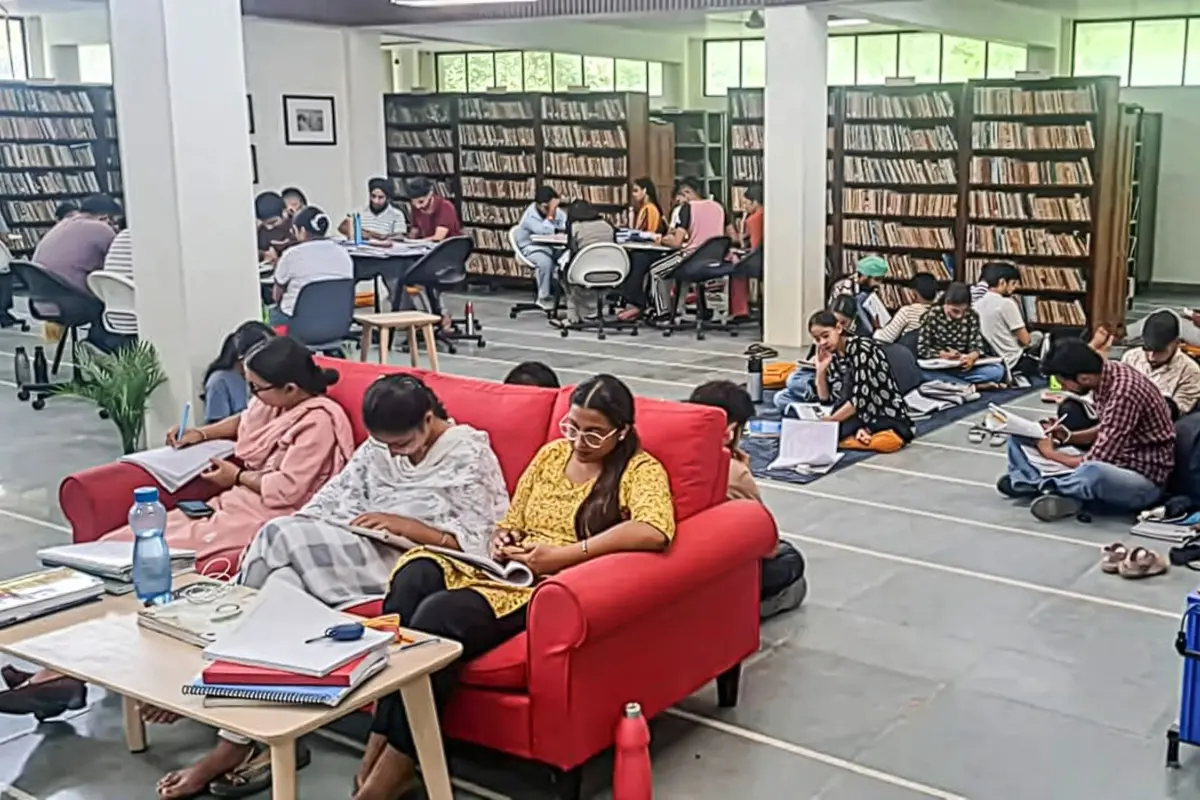
Buildings competing with luxury hotels and world-class facilities – Chief Minister Bhagwant Mann’s Knowledge Revolution Campaign
Under the leadership of Chief Minister Bhagwant Mann, the Punjab government has established 275 ultra-modern libraries in the state’s rural areas, while work continues on 58 more libraries. The Dr. Bhimrao Ambedkar Public Library (Aabha Library) located in Abohar is a splendid link in this chain, whose grandeur has people comparing it to a five-star hotel. It is not just a library but a living proof of the Mann government’s vision and commitment to youth. Videos going viral on social media show people expressing surprise that this is not a luxury hotel but a government library built for common students.
On August 15, 2024, the Chief Minister launched the rural library scheme from Isru village in Khanna. Since then, this scheme has taken the form of a silent revolution across Punjab. In Amritsar district 4, Bathinda 29, Fatehgarh Sahib 10, Ferozepur 21, Ludhiana 15, and Patiala 18 libraries are already operational. Each library is being built at a cost of about 30 to 35 lakh rupees, while district-level libraries cost more than one crore rupees. This investment shows how seriously the Mann government is taking education and youth development.
Talking about Abohar’s Aabha Library, its architecture and design rival any modern corporate office or luxury hotel. These libraries have Wi-Fi connectivity, solar power, digital analog, and other high-level facilities. Each library has air-conditioned reading rooms, RO water supply, CCTV surveillance, computer section, and inverter facilities. These libraries have a rich collection of contemporary literature and curriculum books. For competitive exam preparation, thousands of books related to UPSC, SSC, banking, railway, and other exams are available. Some libraries have more than 65,000 books, and new books are added regularly.
While inaugurating eight libraries in Barnala, Chief Minister Mann said these libraries are igniting new hope in students. Students from remote villages can now access knowledge from around the world while staying in their own village. The Chief Minister expressed hope that these libraries will help change the fate of youth and produce scientists, doctors, and technicians. While inaugurating 12 libraries in Sangrur district, the Chief Minister talked to school students and discussed the benefits of using library resources. He urged villagers to actively maintain the libraries to create a conducive learning environment.
The specialty of these libraries is that they are open seven days a week from 8 AM to 9 PM. Many district-level libraries also have 24×7 study room facilities. A library in Dhuri has been built at a cost of 1.59 crore rupees; it is a two-story building with a covered area of 3,710 square feet. Some libraries even have a canteen where tea, coffee, and snacks are available. Parking arrangements, green areas, and modern landscaping give these libraries the form of a complete educational complex. Separate secure and comfortable study arrangements have been made for women.
These libraries are proving to be a boon for youth preparing for government jobs. Earlier, students had to go to big cities like Chandigarh, Mohali, or Delhi and take expensive library memberships costing thousands of rupees. Jagdeep Singh, a student from Ladda village, says he comes to the library daily and the atmosphere here is very clean and suitable for study. Another student preparing for UPSC says the collection of books here is excellent. Students from Abohar, Ferozepur, Bathinda, and other border districts are especially benefiting, as such facilities were never available in these areas before.
DON'T MISS
The Mann government has not only built new libraries but also renovated old ones. The Sangrur district library has been renovated at a cost of about 1.12 crore rupees, now with seating for 250 students. Old libraries from the colonial era in cities like Dhuri and Abohar have also been modernized. The Chief Minister said libraries across the state will be upgraded on this model. Rural Development and Panchayat Minister Harbhajan Singh ETO said this transformative step reflects the government’s commitment to advancing rural communities through knowledge, education, and empowerment.
These libraries also have significant social and economic impact. Growing awareness towards education is infusing new energy in youth. For the first time, girls from rural areas are coming to libraries in large numbers to study. Naming Abohar’s library after Dr. Ambedkar also conveys a message of social justice and equality. Dalit, backward, and economically weaker section students now have access to everything that was previously only available to the rich. This scheme is truly an excellent example of inclusive development. Rural youth now feel that the government is serious about their future.
Chief Minister Bhagwant Mann has said on many occasions that previous governments were drowned in corruption and ministers looted public money. He said the state now has enough funds for development works, and they are ensuring that public money is spent for public welfare. The library scheme is direct proof of this. After the Aam Aadmi Party’s victory in the Jalandhar by-election, the Chief Minister said the public has appreciated their work, and investment in areas like education is the real development of the state. He called a young IPS officer Robin on stage to inspire students that education is the solution to all social evils.
Punjab’s this library revolution can become a model for other states in the country. When governments invest public money in the right places, positive results come forward. Aabha Library in Abohar and over 275 libraries spread across the state prove that the Punjab government not only makes promises but also fulfills them. In the coming years, these libraries will prepare hundreds of successful officers, doctors, engineers, and teachers who will contribute not only to themselves but to the development of entire Punjab and the country. The Mann government’s this investment is truly an investment in Punjab’s bright future.