

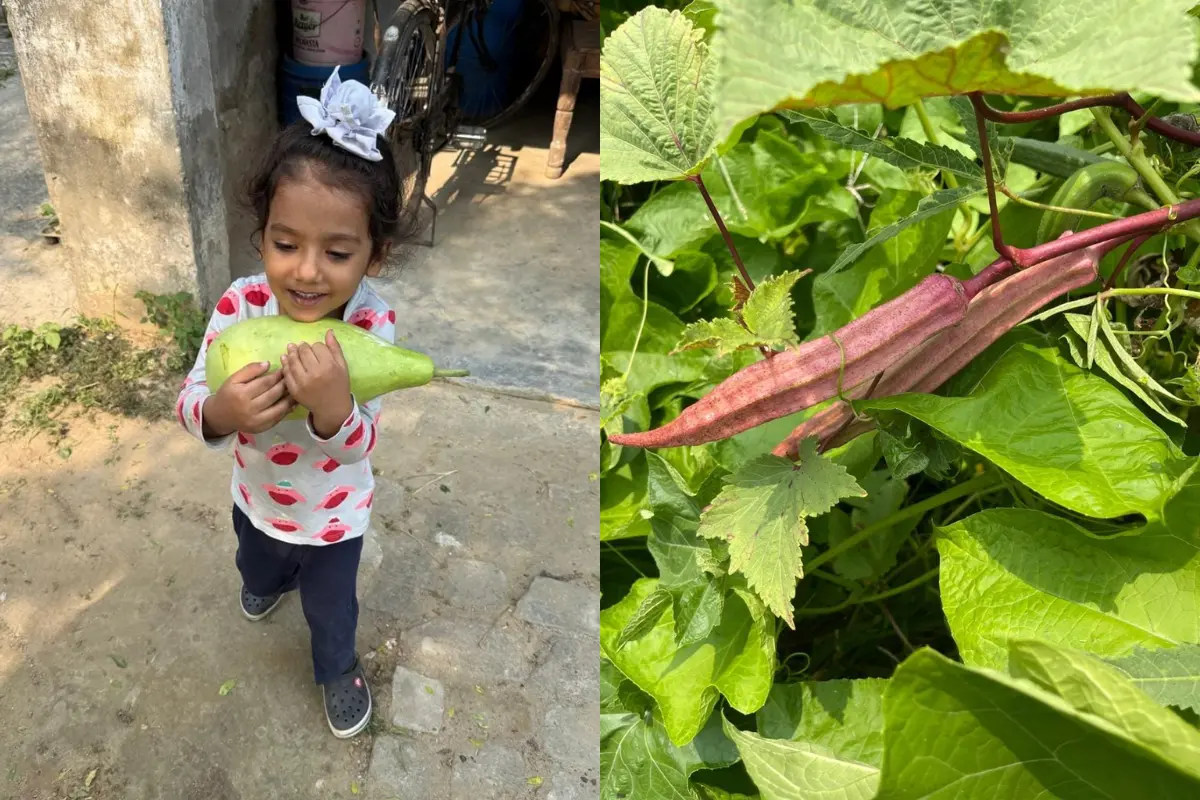
Amninder Nagra’s three-acre farm is more than a personal experiment; it is a living example of how working with soil, water and biodiversity can reshape the way we grow food-an idea at the heart of the first-ever National Conference on Permaculture to be held at The Art of Living International Center in the august presence of the global spiritual master and humanitarian Gurudev Sri Sri Ravi Shankar who is the inspiration and guide behind the permaculture movement, between 22-23 August 2026.
Not many people get to turn a childhood dream into reality. Amninder Nagra considers herself fortunate to be one of them.
“I always had this thought of growing my food naturally on my farm, despite not being from a farming family,” she says.
Though she grew up in Punjab, Amninder settled in Singapore after marriage, and her farming aspirations took a back seat. The lockdown brought an unexpected change. Stuck in India, she enrolled in online permaculture courses and began learning how farms could work with nature rather than against it. The experience strengthened her desire to own land and grow her own food.
Permaculture: Farming With Nature
Permaculture is built around the idea of creating sustainable farming systems by observing nature’s patterns. It brings together soil, water, plants, trees and other elements to create a productive ecosystem.
Amninder’s journey is part of a larger shift in how people are beginning to think about food, farming and their relationship with nature. The global spiritual leader and humanitarian Gurudev Sri Sri Ravi Shankar has played an important role in taking permaculture beyond the perception that growing one’s own food is a pursuit reserved for the affluent or upwardly mobile. Through a simple, accessible programme, he has helped make its principles learnable and practicable for anyone-from urban homes and terraces to rural farms.
The relevance extends far beyond growing food. Permaculture can help conserve precious natural resources by restoring soil health, reducing dependence on chemical inputs, improving water retention and replenishment, supporting cleaner water sources and healthier air, and turning what is usually treated as waste-kitchen scraps, dry leaves and other organic matter-into valuable inputs for the soil. It connects food, health and environmental stewardship into one living cycle, making sustainable agriculture a practical possibility rather than a distant ideal.
Amninder saw its relevance even in her Gurugram home, where she could only practise terrace gardening.
“When I learnt permaculture, I found that even my kitchen waste and dry leaves that I would collect from nearby parks played such a vital role in increasing the fertility of my terrace soil,” she says.
Her experiment grew into a three-acre farm in Dasuya, Hoshiarpur, Punjab. She bought the land in 2020-21 and became a full-time farmer in June 2023 after returning from Singapore.
“My farmland had only a small jungle at the time of purchase. We implemented a full-fledged agro-forestry model only after coming back to India,” she says.
Today, the farm has around 1,000 trees, including 32 varieties of fruit trees and two types of timber trees. Amninder has planted them in 25 rows, leaving a 36-foot gap between rows to grow grains and vegetables.
The arrangement allows different plants to share resources while supporting soil health and biodiversity. Trees also help hold the soil together, regulate water flow, and create conditions for beneficial insects and microorganisms.
However, keeping weeds under control without chemical weedicides was difficult. Labour costs in Punjab added to the challenge.
“My knowledge of permaculture came to my rescue. I applied mulching that helped me control weeds,” she says.
Water management is another part of the system. Trenches help rainwater move naturally through the farm, allowing it to seep into the soil and support crops while reducing dependence on groundwater.
The farm now produces fruits, vegetables, and grains mainly for the family, with some produce sold locally.
A Farm That Serves More Than One Family
The Nagra family grows Sona Moti wheat, basmati rice, corn, masoor, white and black chana, and lobia. Their farm meets about 98% of their vegetable needs. Turmeric, fennel, ajwain, cumin, coriander, and soybeans are also grown.
Around five to six neighbouring families buy turmeric and wheat flour from them.
“Since we’re present in the area, it’s only right that those around us benefit too,” says Amninder.
That belief led to another experiment. During Diwali a couple of years back, she encouraged local women to prepare alsi pinnis using homegrown ingredients and desi cow ghee as corporate gifts. Ingredients were sourced from local farmers and dairy owners. The initiative generated Rs 2 lakh in revenue.
They plan to scale it up this Diwali.
Amninder’s experience also reflects a larger question facing people interested in sustainable farming: how can such practices become financially viable rather than remain a hobby?
That question will be among those explored at the first-ever National Conference on Permaculture 2026, to be held from 22 to 23 August, and will bring experienced practitioners and aspiring farmers together. Sessions will address practical challenges such as acquiring land, understanding legal requirements, accessing subsidies, developing farms, restoring soil and creating sustainable sources of income.
The conference will also focus on farmers who have already moved towards non-chemical agriculture. In its maiden year, the conference has supported the journey of 29 natural farmers from Chhattisgarh who will attend the event, connect with technical experts, receive guidance, network, and explore potential markets.
For Amninder, the goal is closer to home.
“We’ve proven that without synthetic fertilisers or pesticides, robust, healthy food is possible. Now, we want to scale this up and inspire others,” she says.


