

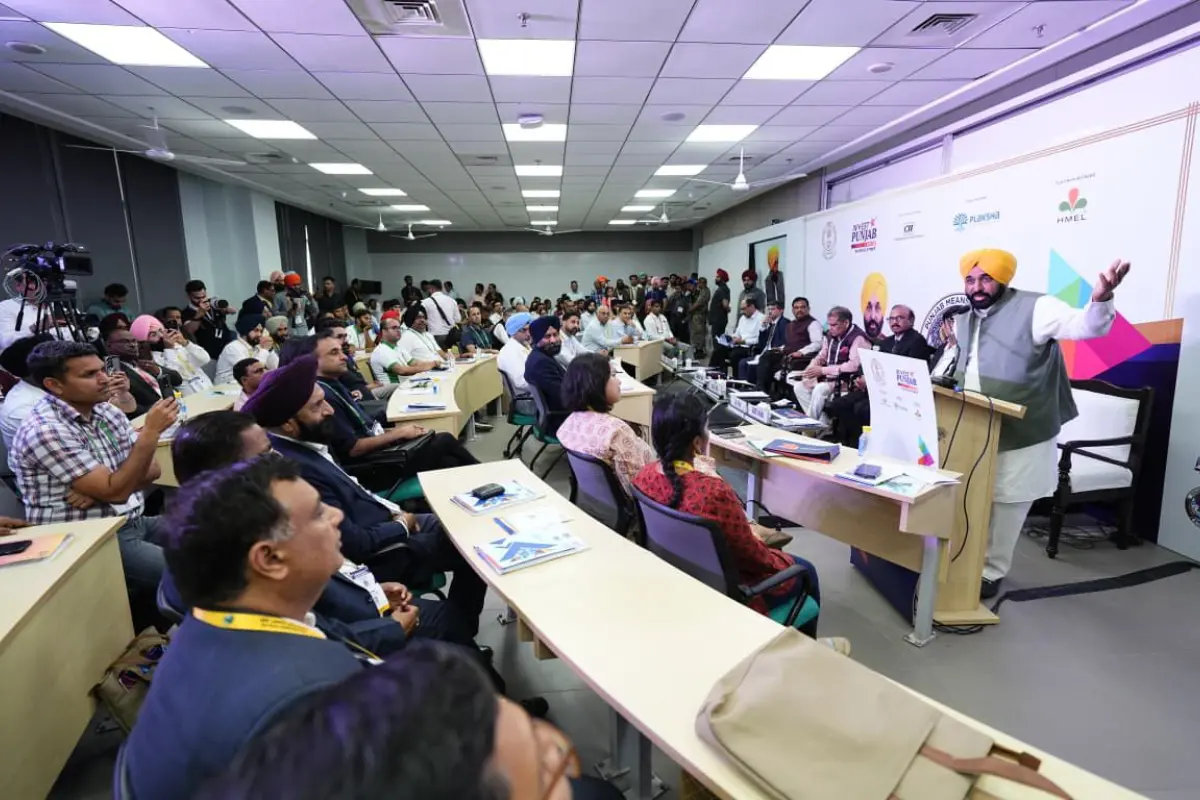
Punjab Chief Minister Bhagwant Singh Mann on Saturday announced that the Punjab Government will establish three world-class exhibition centres at Ludhiana, New Chandigarh (Mohali) and Amritsar to give a major boost to industry and commerce in the state.
Interacting with industrialists during various sessions at the ongoing Progressive Punjab Investment Summit, Punjab Chief Minister Bhagwant Singh Mann congratulated participants for actively brainstorming on key economic and industrial issues affecting Punjab. “Punjab does not have big exhibition centres due to which the industry does not have proper places to showcase their products. To address this gap, the Punjab Government is in the process of setting up three world-class exhibition centres at Ludhiana, New Chandigarh and Amritsar on the lines of Pragati Maidan in New Delhi so that industry gets a strong platform to display their goods and boost economic activity,” said CM Bhagwant Singh Mann.
Highlighting the significance of the Progressive Punjab Investment Summit, the Chief Minister said, “This summit has transformed into a well-managed platform where investors are sharing ideas and exploring opportunities in a big way. This will benefit both Punjab and the investors as we collectively work towards strengthening the state’s economy,” stated CM Bhagwant Singh Mann.
He emphasized that the Punjab Government is committed to strengthening the state’s export-driven economy and helping Punjab transition from traditional agricultural output to value-added exports. “Punjab is the land of revolution and Punjabis adopt new ideas quickly. That is why Punjabis have excelled in every sphere across the world. Our aim is to further strengthen the export-driven economy of Punjab as the state has enormous potential to move from traditional agricultural exports to value-added products,” added CM Bhagwant Singh Mann.
The Chief Minister asserted that the Punjab Government is preparing the state for the next 50 years of economic growth with a clear vision of transforming Punjab into a global export hub. “Our goal is to prepare Punjab for the needs of the next fifty years. We want to develop Punjab as a major export hub. I urge investors to compare Punjab with any other state in the country and they will find that Punjab offers one of the best environments for investment. Though our population is only about 2 percent of the country, the sacrifices of Punjabis for the nation exceed 90 percent,” affirmed CM Bhagwant Singh Mann.
Highlighting Punjab’s contribution to the country’s food security, the Chief Minister noted that the state continues to be the food bowl of India. “Punjab produces around 185 lakh metric tonnes of rice and 125 lakh metric tonnes of wheat. Because of this contribution, Punjab is proudly known as the food bowl of the country,” noted CM Bhagwant Singh Mann.
Describing the Progressive Punjab Investment Summit as a resounding success, the Chief Minister said, “All thirty sessions planned during the summit were fully attended, which shows the strong interest of the business community in Punjab’s growth story. At the same time, we must address the challenge that bumper agricultural production without value addition often creates imbalance between supply and demand,” observed CM Bhagwant Singh Mann.
He highlighted Punjab’s immense potential in food processing and cited examples of several regions known for specialized agricultural produce. “Punjab has tremendous potential in food processing. Pathankot’s litchis, Hoshiarpur’s mangoes and Jalandhar’s potatoes are examples of crops where value addition through food processing can significantly increase farmers’ income,” stated CM Bhagwant Singh Mann.
The Chief Minister emphasized that diversification of agriculture is essential to break the wheat-paddy cycle. “Farmers in Punjab want to move beyond the wheat-paddy cycle, but the challenge is the lack of viable alternatives. Food processing offers a practical solution. Farmers will adopt crops like maize if they receive income comparable to paddy. Therefore, we must ensure that diversification becomes economically viable for farmers,” added CM Bhagwant Singh Mann.
Citing encouraging examples of agricultural diversification, the Chief Minister pointed out that vegetable cultivation has helped improve groundwater levels in some areas. “In certain areas, vegetable cultivation has led to a 57 percent improvement in groundwater levels in the 0–4 meter range. This shows that diversification can benefit both farmers and the environment,” said CM Bhagwant Singh Mann.
He invited investors and delegates to share their ideas directly with the decision-making teams of the Punjab Government and also highlighted the success of the Kisan Ketchup plant at Nabha. “When the Kisan Ketchup plant was first set up in Nabha, tomatoes were imported from Maharashtra. Today, nearly sixty percent of the tomatoes are sourced locally from Punjab after farmers adopted the required varieties. This is a strong example of how agriculture and industry can work together,” stated CM Bhagwant Singh Mann.
Describing Punjab as a blessed land, the Chief Minister also announced enhanced subsidies under the new industrial policy. “Under the new industrial policies, subsidies for food processing industries will now go up to 125 percent. We are also promoting floriculture, which we aim to increase to sixteen percent. The Punjab Government has established a laboratory in Mohali to test pesticide residues for basmati rice growers, and we will ensure MSP support and state intervention if market prices fall below minimum levels,” affirmed CM Bhagwant Singh Mann.
The Chief Minister said that the presence of major international companies already operating in Punjab reflects the confidence of global industry in the state’s industrial ecosystem. “Punjab offers strong advantages such as availability of raw material, established industrial clusters and proximity to key markets. The state already has strong sectors including textiles, auto components, FMCG products and construction materials,” noted CM Bhagwant Singh Mann.
He further pointed out that Punjab is also emerging as an important hub for agrochemicals and fertilizers. “Punjab’s large agricultural economy creates strong demand for agrochemicals and fertilizers, and the state already hosts major players in this sector,” added CM Bhagwant Singh Mann.
The Chief Minister said that the Punjab Government recently launched the Industrial & Business Development Policy 2026, which he described as one of the most progressive policy frameworks in India for industrial growth. “The Industrial & Business Development Policy 2026 provides strong support for investors, and Invest Punjab functions as a dedicated one-stop facilitation office to assist industries at every stage from approvals to project implementation,” said CM Bhagwant Singh Mann.
DON'T MISS
Reiterating Punjab’s historic role in ensuring national food security, the Chief Minister said that agriculture and allied sectors continue to support a large share of the state’s workforce. “Punjab has always been the food bowl of India and our farmers have played a historic role in ensuring food security for the nation. Agriculture and allied sectors remain a key pillar of our economy,” stated CM Bhagwant Singh Mann.
However, he emphasized that the next phase of agricultural growth must focus on value addition. “The future of Punjab’s agriculture lies not only in producing crops but in converting them into processed and branded food products for domestic and international markets,” asserted CM Bhagwant Singh Mann.
He noted that global food consumption patterns are rapidly changing with increasing demand for ready-to-eat foods, packaged products, health foods and processed agricultural products. “This change in global consumption patterns presents a major opportunity for Punjab to move from farm produce to food products,” said CM Bhagwant Singh Mann.
The Chief Minister highlighted that Punjab already possesses strong infrastructure to support this transformation. “Punjab already has Mega Food Parks, cold storages, food storage depots and strong logistics connectivity that support modern food processing and efficient supply chains,” added CM Bhagwant Singh Mann.
He said that the Punjab Government’s vision is to build strong partnerships between farmers and industry. “When farmers, food processors, exporters and logistics providers work together, it increases farmers’ income, generates employment for youth and expands export opportunities for Punjab,” affirmed CM Bhagwant Singh Mann.
The Chief Minister reiterated that Punjab has long been known for enterprise, manufacturing strength and strong global trade connections. “Today the Punjab Government is working to further strengthen Punjab’s position as an export-driven industrial economy,” noted CM Bhagwant Singh Mann.
He highlighted that Punjab currently exports goods worth over USD 7 billion and has a strong presence in sectors such as agriculture, engineering goods, textiles, auto components and pharmaceuticals. “With more than fourteen lakh MSMEs, Punjab has a strong base of enterprises that contribute to exports, employment and industrial growth,” stated CM Bhagwant Singh Mann.
The Chief Minister said that the Punjab Government aims to transform Punjab into a major export hub of North India by combining manufacturing strength with efficient logistics systems. “We invite industry leaders, exporters and logistics companies to partner with Punjab in expanding our global footprint,” added CM Bhagwant Singh Mann.
Highlighting the importance of sustainable development, the Chief Minister also spoke about Punjab’s transition towards clean and reliable energy. “Punjab is steadily moving towards clean and reliable energy as part of our long-term development strategy. Renewable energy will play a key role in meeting growing industrial demand, agricultural needs and emerging sectors such as electric mobility,” said CM Bhagwant Singh Mann.
He added that Punjab has a natural advantage in bioenergy because of its strong agricultural base. “Punjab produces nearly twenty million tonnes of paddy straw every year. What was once seen as a challenge is now being converted into an opportunity through biomass power, compressed biogas and waste-to-energy projects,” stated CM Bhagwant Singh Mann.
“Bioenergy will help address stubble management, generate additional rural income, support clean fuel transition for industry and build a circular economy where agricultural residue becomes an energy resource,” added CM Bhagwant Singh Mann.
On the occasion, Cabinet Ministers Sanjeev Arora and Gurmeet Singh Khudian along with other dignitaries were also present.