

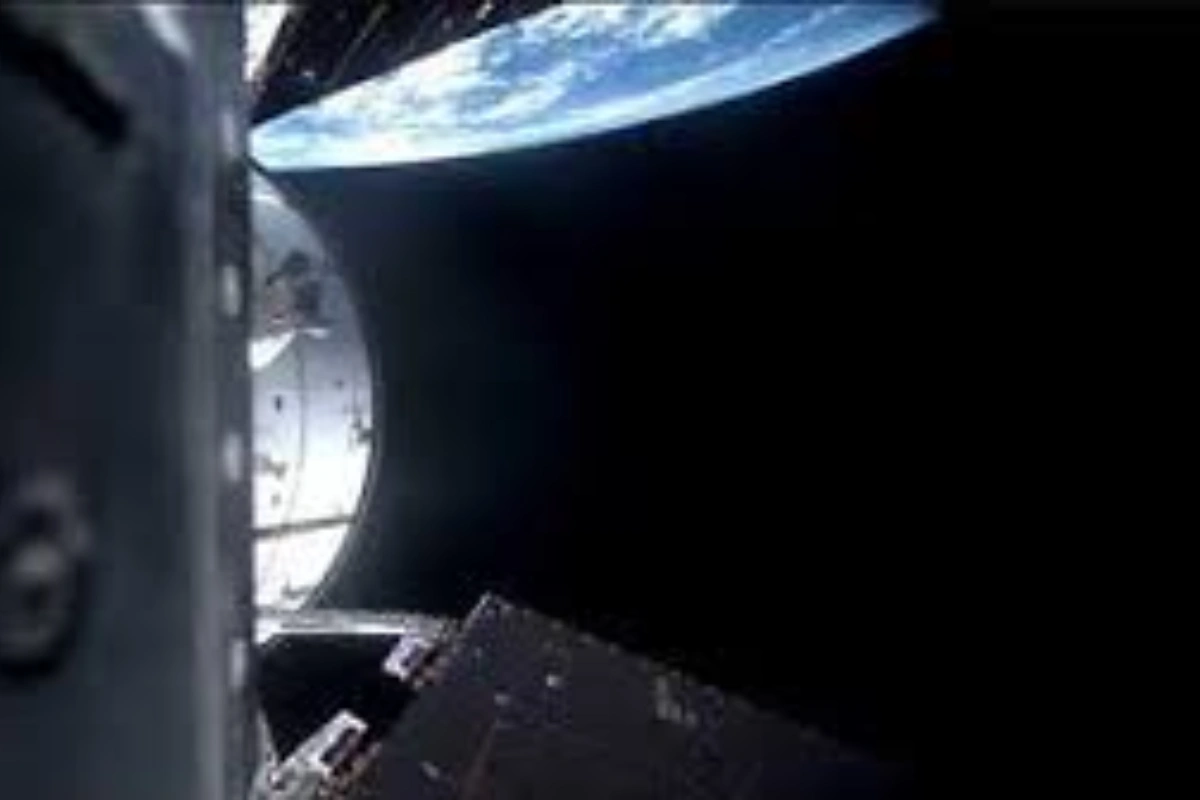
NASA’s Artemis II mission is happening in deep space, but millions of people on Earth are also following it in real time. The Orion spacecraft is the main focus of this digital experience. Its position, speed, and trajectory are constantly monitored by advanced telemetry systems and displayed on tools like the NASA Artemis Real-time Orbit Website (AROW).
DON'T MISS
How Real-Time Tracking Works
Orion has a network of sensors on board that always check its speed, position, and orientation. NASA’s ground stations receive this data via radio signals and send it to Mission Control. From there, platforms like AROW turn raw telemetry into easy-to-read graphics, such as interactive maps, trajectory lines, and mission timelines.
These systems work almost like a “space GPS,” showing where Orion is in the Earth-Moon system. Key metrics like the distance from Earth, the distance to the Moon, and the mission elapsed time (MET) are updated almost in real time.
Speed and Position: Moving Numbers
At the beginning of the mission, especially after trans-lunar injection, Orion speeds up quickly, reaching speeds of more than 3,700 mph. As it gets farther away from Earth, often more than 100,000 miles, its speed slowly stabilizes because of the pull of gravity.
These changes are shown in real time by live trackers. Users can see Orion’s path moving away from Earth, with the speed and distance changing every second.
The Homeward Arc: A Return Driven by Gravity
The “free-return trajectory” of Artemis II is one of the most interesting things about it. After going around the far side of the Moon, Orion naturally curves back toward Earth. This is mostly because of the Moon’s gravity, not because it uses a lot of fuel.
AROW and other similar tools make this beautiful arc clear by showing the outbound leg, lunar flyby, and return path as a smooth curve.


