


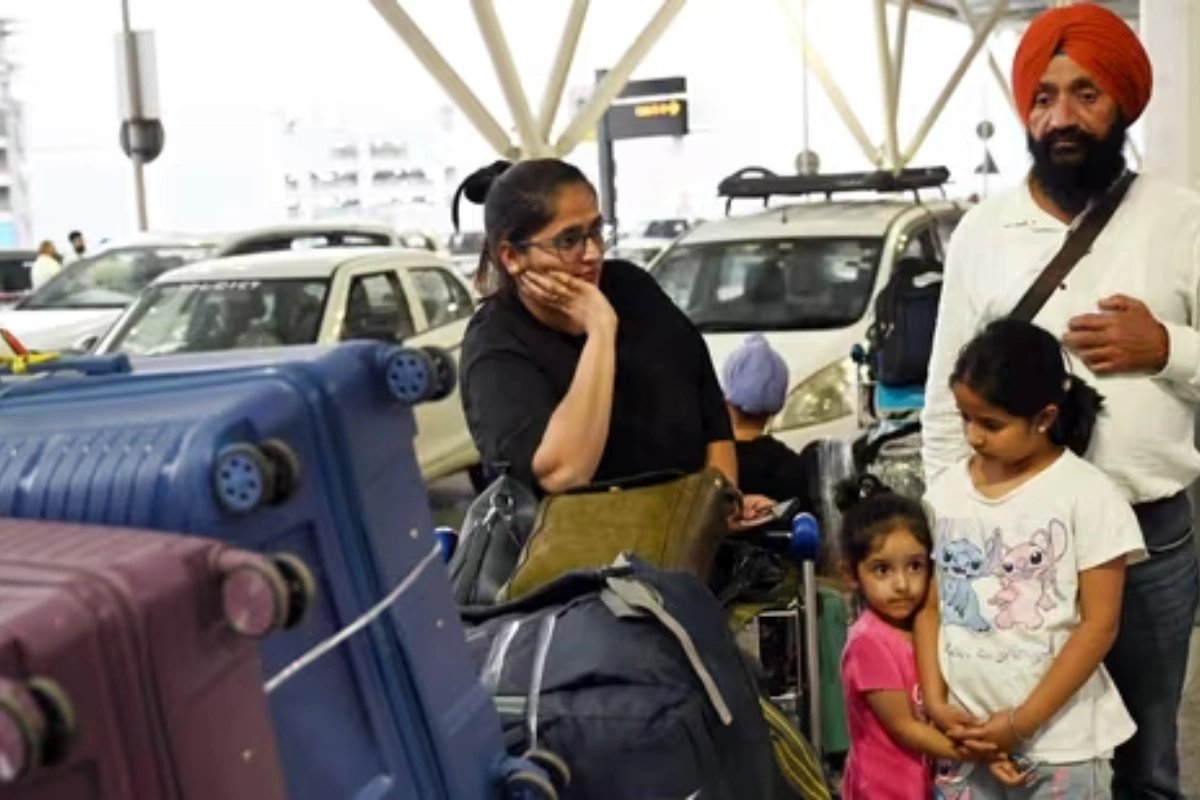
Iran US Israel War: At least 100 international flights, both arrivals and departures, were cancelled at Delhi’s Indira Gandhi International Airport (IGIA) on Sunday as escalating tensions in West Asia sent shockwaves through global aviation networks. With west-bound flights crippled for a second consecutive day, hundreds of passengers found themselves stranded at the airport, scrambling for alternatives amid widespread uncertainty.
The disruptions come as airlines across the globe reassess flight paths through sensitive airspace in the Middle East. As geopolitical tensions intensify in the region, aviation authorities and carriers are prioritizing passenger safety, leading to sudden cancellations, rerouting, and operational delays that are affecting thousands of travellers worldwide.
Iran US Israel War-Chaos At The Terminals
Despite hundreds of cancellations being announced in advance, scenes at Delhi airport were marked by confusion and long queues. Many passengers, unaware of last-minute schedule changes or hoping for alternate arrangements, arrived at the airport only to discover their flights had been called off.
Ticketing counters were crowded as anxious travellers attempted to rebook flights or explore alternative routes. For many, the uncertainty was compounded by limited seat availability on remaining services and rising ticket prices on unaffected routes.
DON'T MISS
Airport authorities urged passengers to check with their respective airlines before heading to the airport. However, for those already en route or traveling from outside Delhi, the advisory came too late. Families with children, elderly passengers, and business travellers faced hours of waiting as they sought clarity from airline representatives.
Why Flights Are Being Cancelled?
The primary reason behind the large-scale cancellations is the closure or restriction of critical airspace corridors across parts of West Asia. Airlines operating routes to Europe, North America, and parts of Africa often rely on Middle Eastern airspace to ensure the most efficient flight paths from India.
When airspace is restricted due to conflict or security concerns, carriers must either reroute flights sometimes adding several hours to travel time or cancel them altogether. Longer routes also mean higher fuel consumption, additional crew requirements, and logistical complications.
Global aviation has long been sensitive to geopolitical instability in the Middle East due to the region’s strategic location as a crossroads between Asia, Europe, and Africa. Major international hubs in the Gulf serve as connecting points for millions of travellers, and disruptions there ripple across continents.
Impact On International Connectivity
Delhi, as one of India’s busiest international gateways, bears the brunt of such disruptions. Indira Gandhi International Airport handles a substantial volume of long-haul flights daily, many of which operate westward through Middle Eastern airspace.
The cancellation of over 100 flights over just two days underscores how interconnected global aviation systems are. A crisis in one region can quickly disrupt travel plans thousands of kilometres away.
Passengers flying to destinations such as London, Paris, New York, Toronto and various Gulf cities were among those affected. Transit passengers connecting through Middle Eastern hubs also faced missed connections and prolonged layovers.
Airlines are now working to accommodate affected passengers on alternative routes, including flights through Central Asia or southern corridors where feasible. However, such rerouting options are limited and may not be viable for all aircraft types or destinations.