

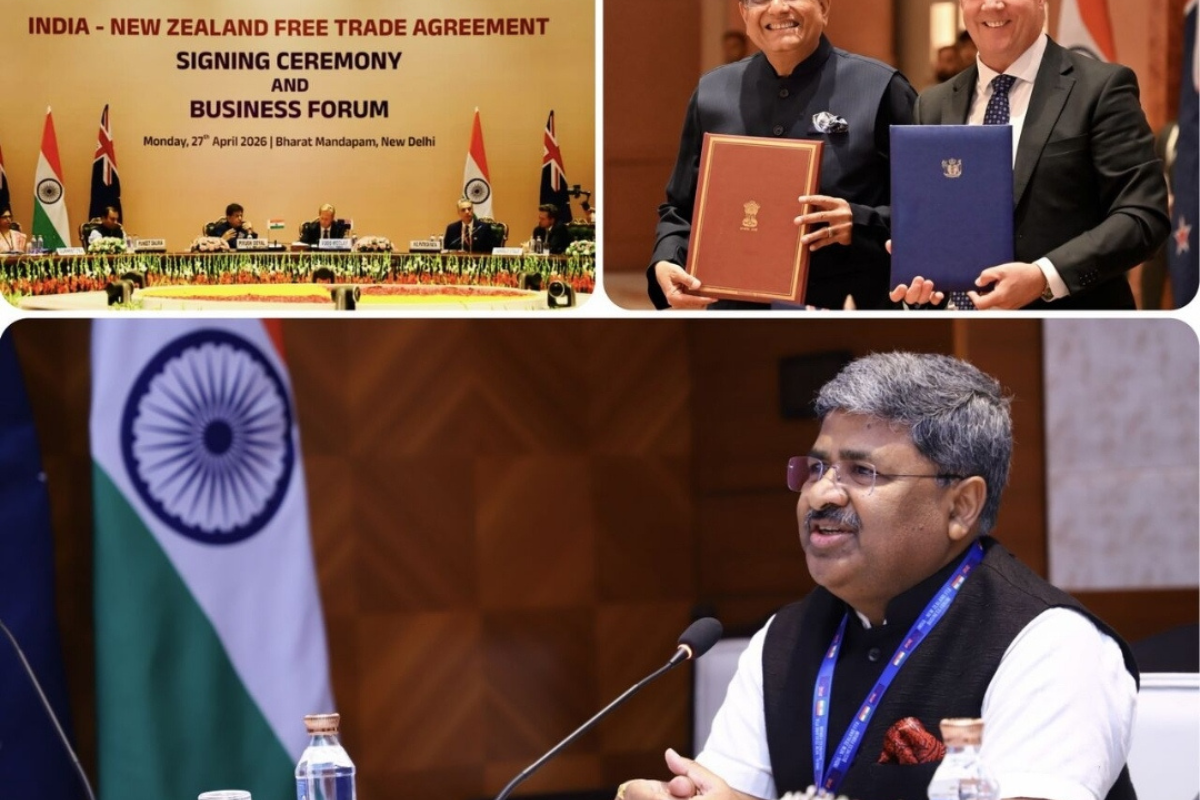
The strongest agreements between nations are remembered not for what they liberalise, but for the human capability they help build.At the sectoral round table of the India–New Zealand Business Forum, Bharat Mandapam, on the occasion of the signing of the India–New Zealand Free Trade Agreement, I shared this view in my capacity as Chairman, ASSOCHAM National Education Council.Trade agreements are too often evaluated narrowly, through tariffs, market access, and sectoral gains. These matter. But the architecture of a truly consequential bilateral agreement must also address knowledge systems, institutional trust, and the structured movement of human capability across borders. That is where lasting national interest is served.India brings scale, demographic depth, and one of the world’s largest higher education ecosystems.
New Zealand brings a compact, globally trusted model of applied learning, vocational rigour, sustainable agriculture, and research-linked practical systems. These are not competing strengths; they are complementary ones, and this FTA creates the policy ground to connect them purposefully.Education and skilling must not remain peripheral to trade architecture. I recommended a structured bilateral education and skills framework, covering joint degree and diploma programmes, academic credit pathways, mutual recognition of qualifications, sector-based skill partnerships, and trusted digital credential systems.
DON'T MISS
Without such a framework, the agreement will deliver economic value but fall short of its civilisational potential.Significantly, Yoga and AYUSH have been recognised within the FTA itself. This is not a symbolic gesture. It is a policy acknowledgement that India’s knowledge systems in wellness, preventive health, and integrative medicine carry contemporary relevance and bilateral value. This recognition should now be followed by concrete cooperation frameworks, research partnerships, practitioner mobility pathways, and quality standards that give this commitment real institutional weight.Agreements are signed at tables.
Their value is built in classrooms, laboratories, farms, and hospitals. The India–New Zealand FTA has the foundation to be both an economic instrument and a knowledge partnership of lasting consequence.My compliments and regards to Hon’ble Shri Piyush Goyal ji, Minister of Commerce & Industry, India and Hon’ble Mr. Todd McClay, Minister of Trade and Agriculture, New Zealand for concluding this agreement with purpose, clarity, and commendable speed.
About Kunwar Shekhar Vijendra
Kunwar Shekhar Vijendra is the chancellor of Shobhit University Meerut, and Shobhit University Gangoh, Uttar Pradesh, India. He is also a prominent social entrepreneur based in New Delhi, India who carries leadership roles in many organizations and has been awarded several honorary positions and awards including Lions International Award for Selfless Service to Humanity.