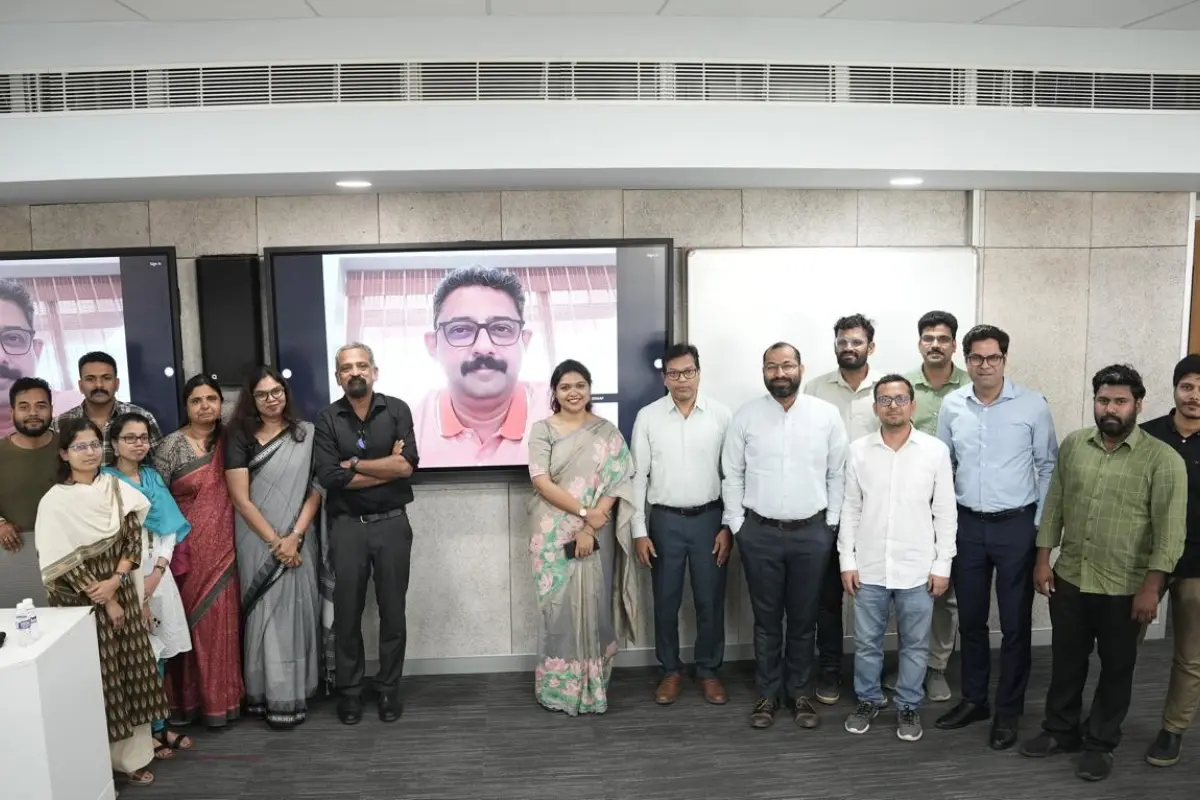
The Department of Economics, Easwari School of Liberal Arts, organised a seminar titled “Cash Transfers and the Politics of Welfare: Rethinking Social Protection in India.” The session brought together three eminent scholars and policy practitioners namely, Dr Dipa Sinha, Associate Professor at the Centre for the Study of the Indian Economy, Azim Premji University; Prof. Ramakumar R, Professor at the Centre for Study of Developing Economies, School of Development Studies, Tata Institute of Social Sciences, Mumbai; and Mr Akshaya Limal, Senior Consultant (Nutrition), UNICEF India, Odisha. The seminar provided a rich platform for critical engagement and scholarly deliberation on the evolving landscape of social protection in India.
Dr Dipa Sinha spoke on the politics underpinning cash transfer programmes, helping participants conceptualise their expansion within India’s welfare architecture. She examined both conditional and unconditional cash transfers, particularly those targeted at women, and discussed their increasing prominence during electoral cycles. Referring to schemes such as Subhadra Yojana (Odisha), Stree Suraksha (Kerala), Kalaignar Magalir Urimai Thogai Thittam (Tamil Nadu), and Lakshmir Bhandar (West Bengal), she analysed their design, scope, and political economy. She emphasised that while these schemes are often associated with particular parties or states, their adoption reflects a broader, cross-party consensus on direct income support. Drawing parallels with Latin American experiences, she situated India’s welfare shifts within a global context. At the same time, she raised important concerns regarding fiscal prioritisation, noting that state-level cash schemes sometimes assume greater visibility than national programmes. She concluded by posing a critical question to the audience: can such transfers substitute for sustainable livelihoods? In this context, she briefly introduced debates around Universal Basic Income (UBI) as a conceptual reference point.
DON'T MISS
Mr Akshaya Limal examined the interplay between cash, in-kind transfers, and welfare politics in Odisha, drawing from his extensive experience in public health and nutrition monitoring. He discussed programmes such as the Mamata Scheme and the Mukhyamantri Sampoorna Pushti Yojana (MSPY), highlighting their role in addressing maternal and child nutrition. His lecture emphasised the importance of monitoring systems, evidence-based design, and the integration of welfare schemes with broader public health objectives. He reflected on how implementation challenges, targeting mechanisms, and institutional capacity shape the effectiveness of both cash and in-kind modalities.
Prof. Ramakumar offered a critical assessment of contemporary welfare mechanisms, questioning whether cash transfers alone can meaningfully alleviate poverty in the long run. Tracing the intellectual origins of social protection to the Universal Health Coverage movements of the 1960s, when welfare was framed as a social right rather than a market instrument, he highlighted the shift in policy language toward cost efficiency and fiscal minimisation. He argued that cash transfers have become the most “visible” form of social assistance, often overshadowing the “invisible” yet foundational role of public services. This shift, he suggested, reflects a broader transformation in which welfare increasingly appears as an individual entitlement rather than a collective social commitment. He concluded by calling for a reassessment of the normative foundations of social policy, emphasising the strengthening of labour rights and the reaffirmation of welfare as a fundamental social right. The seminar thus fostered a rigorous and multidimensional debate on the economics, politics, and future trajectory of social protection in India.