


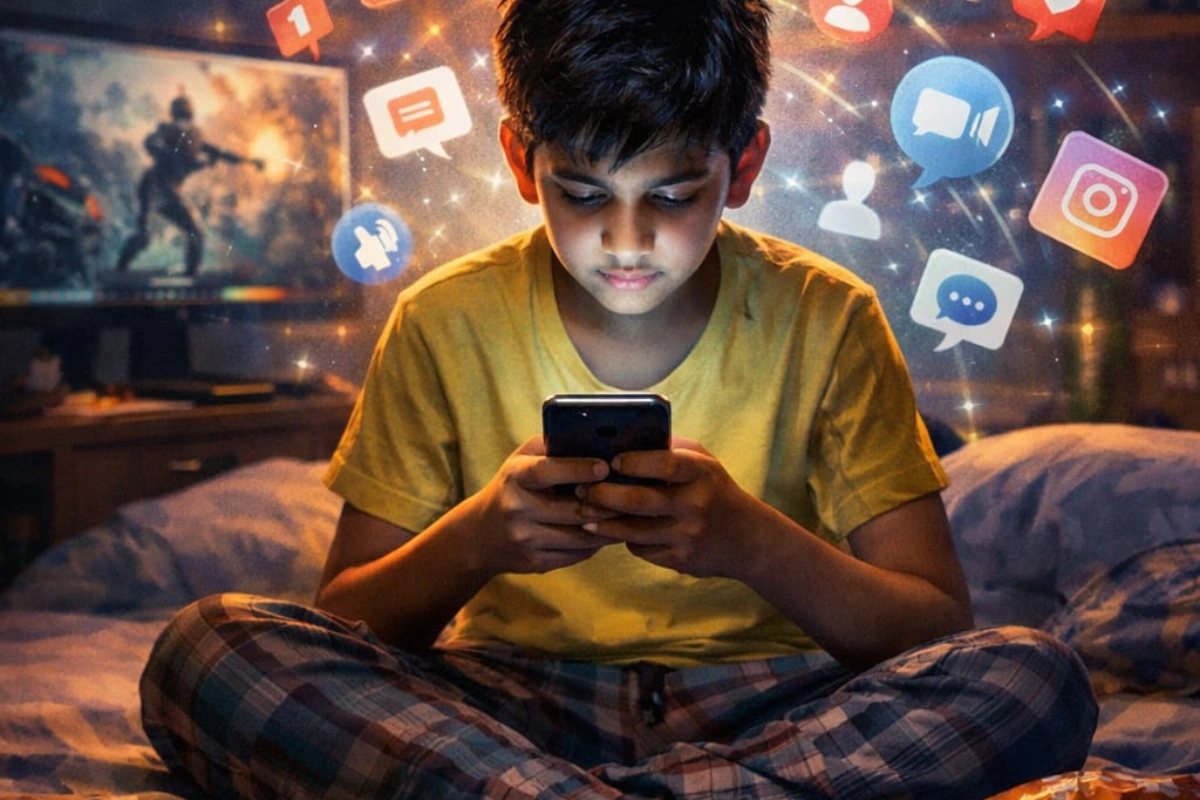
Arijit Das was sixteen and glued to his phone the way most of his generation is, except with him, the screen had become a hiding place. Post lockdown, anger, self-doubt, and body image issues had taken hold, and every time the pressure built, he retreated further into the device and further away from his family. His parents felt helpless. But this story has a happy ending…
Das’s case is not an isolated incident. There is a noticeable rise in depression, anxiety, sleep disorders, and other mental health issues among school-going children and young adults in India, which are strongly linked to increased screen time. Studies indicate that excessive screen use correlates with digital addiction and cyberbullying and eventually leads to poorer mental well-being.
While teen screen addiction is a growing crisis globally, adolescents in India spend an average of 3.2 hours to over 4 hours daily on screen, with 68% to 83% of them exceeding the recommended two-hour limit. From online classes and social media to gaming and streaming platforms, digital devices are deeply embedded in a teenager’s daily routines. The problem starts when the use of digital devices becomes a compulsive and excessive habit, where it interferes with their studies, sleep, relationships, and overall well-being.
The roots of the problem run much deeper. In nuclear families, where both parents are working, children often feel a sense of loneliness. Exhausted after a long day’s work, the parents struggle to find time and energy to spend quality time with their children, and the children, in turn, tend to immerse themselves in their digital devices. As a result, obesity, poor eyesight, lack of social interaction, loss of appetite, and aggression are on the rise among teenagers.
“I have observed the adverse impact of mobile devices across all age groups. One of my teenage cousins had pushed his mom once because she was about to switch off his computer,” says Bivasree, a school teacher in Bengaluru. “In middle school and high school, children are exposed to adult content, and addiction to pornography through various websites is on the rise, with no one to supervise their social media accounts. Many stay up late using social media, struggle to wake up the next morning, and are often reluctant to attend school. It also affects their cognitive abilities, making it harder for teens to focus on studies or long-form tasks”, she adds.
The challenges are many, but how can they be effectively tackled? Attempts to reduce screen time often trigger aggression in children, making the process more complicated. As a result, many parents are now turning to alternative approaches, like The Art of Living’s Intuition Process for children and teens, which has proven path-breaking in helping children effortlessly come out of their screen habits, focus better, and tap into their intuitive abilities.
Arijit’s father, Dr Abhijit Das, remembers moments when Arijit expressed thoughts no parent wants to hear. But once Arijit underwent the Intuition Process, cognized by the global spiritual master Gurudev Sri Sri Ravi Shankar, that included a blend of yoga, pranayama exercises, guided meditations, breath-led settling, and simple tools for self-regulation, his teachers noticed a shift within weeks. He regained his focus, began studying again, and eventually scored ninety percent. “I work in medicine,” his father said, “and I can say this: medicine alone cannot do what meditation did for my son. These practices gave me my child back.”
DON'T MISS
“After IP, for the first time, I felt calm instead of chaos,” says Arijit Das. The anger eased, the phone loosened its grip, and the boy, once driven by every notification, began to feel guided from within.
“A lot of parents who want to reduce screen time for their children come to us. The Art of Living has this beautiful process called the ‘Intuition Process’ that is very effective for digital detox,” says Dipankar Chakraborty, a senior Art of Living faculty.
The benefits that practitioners and researchers describe are not mutually exclusive. Improved awareness keeps children safe and focused on the task at hand, they show more interest in learning, they develop photographic memory, able to give exams without stressing or anxiety. Children become more confident in the face of the unknown, emotionally stronger, and positively receptive to criticism, qualities that foster better communication and sharper academic performance.
“Teenagers are full of energy. They have this great urge to create something, but they don’t know how to channelise their energy. So they often turn to gaming and social media platforms in search of something new. And these platforms, online games, and instant messaging apps are designed to be engaging and often triggering dopamine-driven reward cycles. As the teens seek constant stimulation and peer approval, this makes them particularly susceptible to the screens. We have some specialised techniques, meditations, and training that effectively help them fix their mindset. In one or one and a half months, they become more focused, confident, and calm,” says Chakraborty.
Yet another technique that many experts recommend to replace screen-driven dopamine hits is the powerful and healing practice of Sudarshan Kriya, the Art of Living’s signature breathing technique. It works wonders to reduce stress and increase the happiness quotient. “Gurudev Sri Sri Ravi Shankar says, you cannot control the mind from the level of the mind. But you can do it from the level of breath. And we see transformations every day. OCD and aggressive behaviour among teens get reduced significantly after practicing these breath-based techniques,” Dipankar informs.
Are the teenagers open to these processes?
“Oh yes. See, they are extremely intelligent. They can see what truly adds value to their lives,” says Chakraborty.
In today’s hyper-connected world, screens have become an inseparable part of our daily lives. Our teens cannot be excluded from its influence altogether. But experts like Dipankar Chakraborty, who has been teaching the Intuition Process for more than ten years, suggest keeping the teens physically active and making them learn Yoga and Pranayama, as time-tested remedies. Only then can they maintain a healthy balance while enjoying the undeniable benefits of technology, which plays a vital role in education and communication. “Technology should enhance our teens’ lives, not control them,” Chakraborty says.