


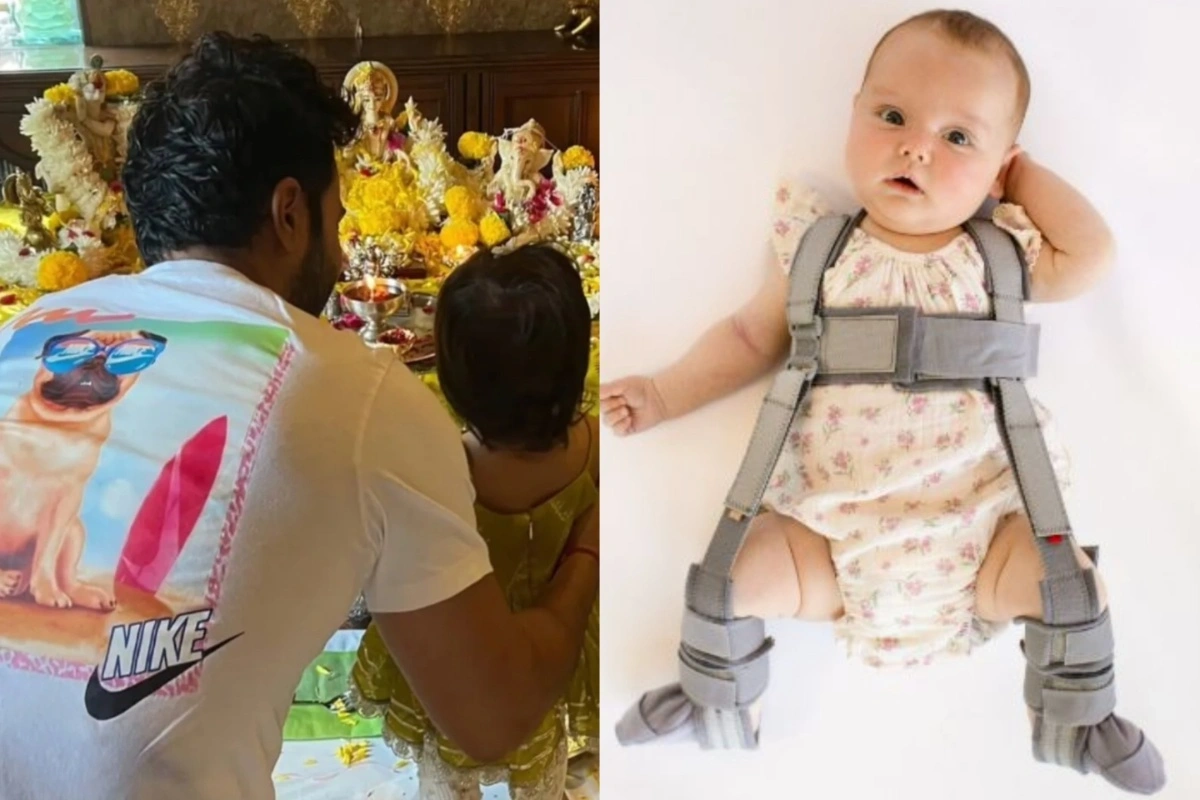
Actor Varun Dhawan recently shared a personal and emotional story about his daughter, Lara. During a podcast, he revealed that she was diagnosed with Developmental Dysplasia of the Hip (DDH) when she was around one-and-a-half years old. His revelation has raised concern among parents, especially because this condition often goes unnoticed in the early stages.
Varun explained that DDH caused his daughter’s hip joint to slip out of place. This made one leg appear shorter than the other. As a result, she had difficulty walking and running and developed a limp. He also warned that if such a condition is not treated on time, it can lead to serious issues like early arthritis or spine-related problems.
Lara underwent a medical procedure to correct the hip joint. Thankfully, it did not require full surgery. However, her recovery was not easy. She had to stay in a spica cast for nearly two-and-a-half months. Varun described this phase as emotionally tough, especially seeing his child go through anaesthesia and adjust to the heavy cast. He also noted that while such conditions are often detected early in Western countries, awareness in India is still limited.
What Is Developmental Dysplasia Of The Hip (DDH) And Why Is It Often Missed
Developmental Dysplasia of the Hip (DDH) is a condition where a baby’s hip joint does not form properly. In a healthy hip, the ball of the thigh bone fits well into the socket. But in DDH, the joint can be loose or unstable, which allows the ball to slip out.
What makes this condition worrying is how common yet hidden it is. Around 1 in 1,000 babies are born with hip dysplasia. However, early hip instability can be seen in up to 1 in 60 newborns, making it more common than many people think.
Another major concern is that many babies show no symptoms at birth. This means a child may look completely normal while the condition develops silently. In many cases, parents only notice a problem later, when the child starts walking late or develops a limp.
DDH Treatment And Early Signs Parents Must Not Ignore
In a video on YouTube, a paediatric orthopaedic expert explained why early diagnosis is so important and also reassured parents that treatment can be simple if done on time.
DON'T MISS
He said, “I am Dr Sepa, pediatric orthopaedic surgeon at Pinnacle Author Center Hospital, Tani. Uh, today I am going to talk about a condition which is a bit rare, but nevertheless, parents of newborn babies should be aware of this condition. So I’m going to talk about a condition called developmental dysplasia of the hip, also called DDH. Sounds a bit scary, but the good news is that if we find it early, it is usually very simple to treat.”
The doctor explained the condition in simple terms. “So imagine that your baby’s hip joint is like a ball which rotates in a socket. So in a healthy hip joint, the ball sits perfectly inside the socket. However, hip dysplasia is a condition where the fit isn’t quite right. The cup may be a bit too shallow or the joint may be too loose, which allows the ball to slip out of place.”
The expert also shared that some babies are at higher risk. These include firstborn babies, baby girls, and those born in a breech position. However, DDH can still occur even without these risk factors.
Parents should watch out for early warning signs. He said, “So as a parent, what are the red flags which you should look out for? First look at the skin folds on your baby’s thighs. Are they uneven? If it is so, it could be DDH. Secondly, does one leg appear shorter than the other? Third red fact, you might notice that one hip is less flexible than the other during a diaper change.”
In older babies, signs may include limping or a waddling walk. The doctor stressed that early diagnosis makes treatment easier and less painful. He said, “Early diagnosis is everything… For a newborn up to 6 months of age, we often use a simple soft brace… It is not at all painful.”
However, if the diagnosis is delayed, treatment becomes more complex. The doctor added, “If diagnosed later… we might need to put the hip back in under anaesthesia and use a special cast… However, in older children… it may even require surgery.”


 diagnosis. Doctor warns of consequences and suggests to act early.)