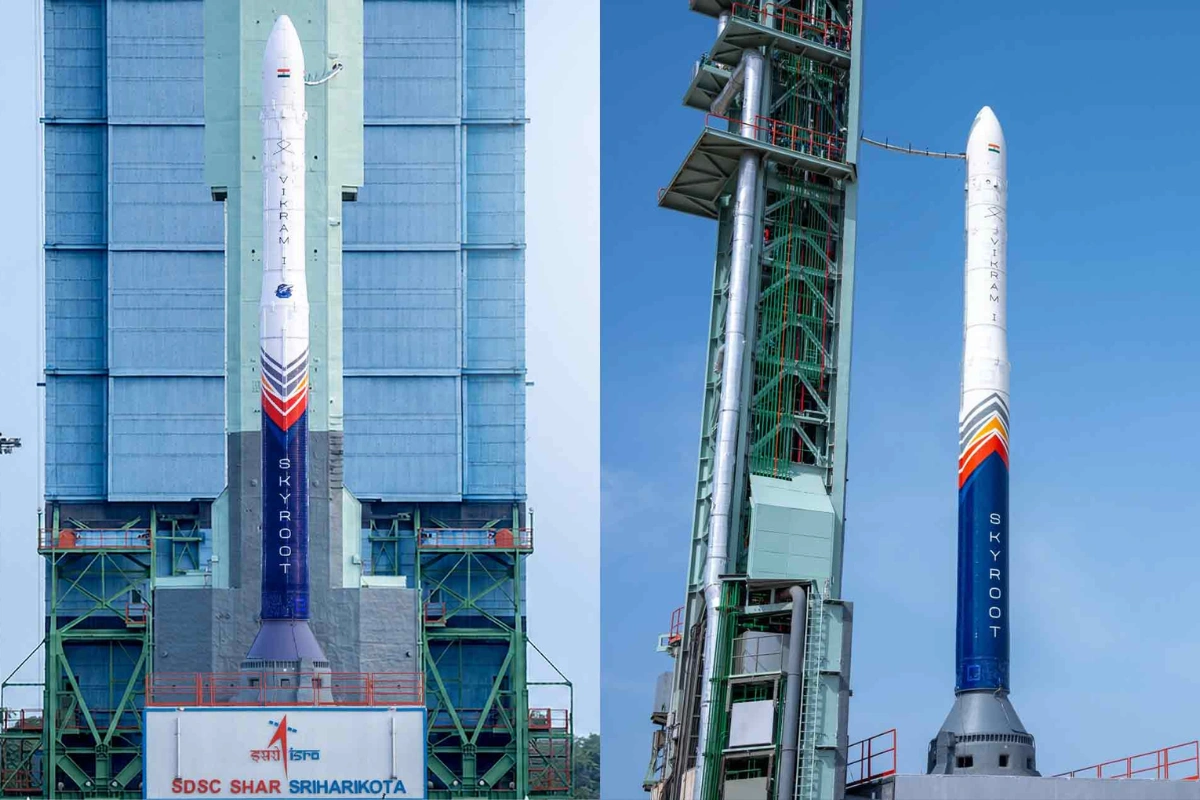
For years, India’s private space firms mostly built parts for ISRO-led missions. Skyroot Aerospace’s Vikram-1 launch under Mission Aagaman changes that, marking the first time an Indian startup has designed, built, and flown a complete orbital rocket entirely on its own.
1. Complete In-House Rocket Development
Unlike earlier arrangements where Indian private firms largely supplied components or subsystems to ISRO, Vikram-1 was designed, built, and tested entirely by Skyroot. The four-stage, 20-metre rocket uses carbon composite structures, 3D-printed engines, and solid-fuel boosters developed in-house, proving an Indian startup can own the full rocket stack.
DON'T MISS
2. End-to-End Mission Ownership
Skyroot handled everything from propulsion and avionics to payload integration and launch operations for Mission Aagaman, rather than contributing parts to a larger government-led mission. This end-to-end control signals a maturing capability to run complete orbital campaigns independently.
3. Commercial Payload Capacity
Vikram-1 is built to carry satellites up to 350 kg into Low Earth Orbit, targeting an altitude of 450 km. Carrying payloads from multiple domestic and international customers on its very first flight shows Skyroot operating as a genuine launch service provider, not just a technology demonstrator.
4. Scalable Production Ambitions
Company leadership has stated plans to manufacture close to one rocket per month between Vikram-1 and its upcoming variant, aiming for a launch cadence rivalling established international players. This production mindset moves Skyroot from one-off builds to an operator model.
5. Symbol of India’s Private Space Policy Reforms
Backed by a valuation exceeding a billion dollars and years of government space-sector liberalisation, Skyroot’s flight represents the broader ecosystem shift, where Indian startups now compete for global small-satellite launch contracts instead of remaining subcontractors.
What’s Next
With in-flight data from Mission Aagaman, Skyroot plans to refine Vikram-1 for regular commercial service, positioning India’s private space industry as a credible global launch alternative.