

Vande Mataram: The Union Government has issued a 10-page order that directs that the national song Vande Mataram would get preference if the national anthem and national song are played or sung together. In other words, Vande Mataram would be played first followed by Jana Gana Mana.
The Vande Mataram Directive

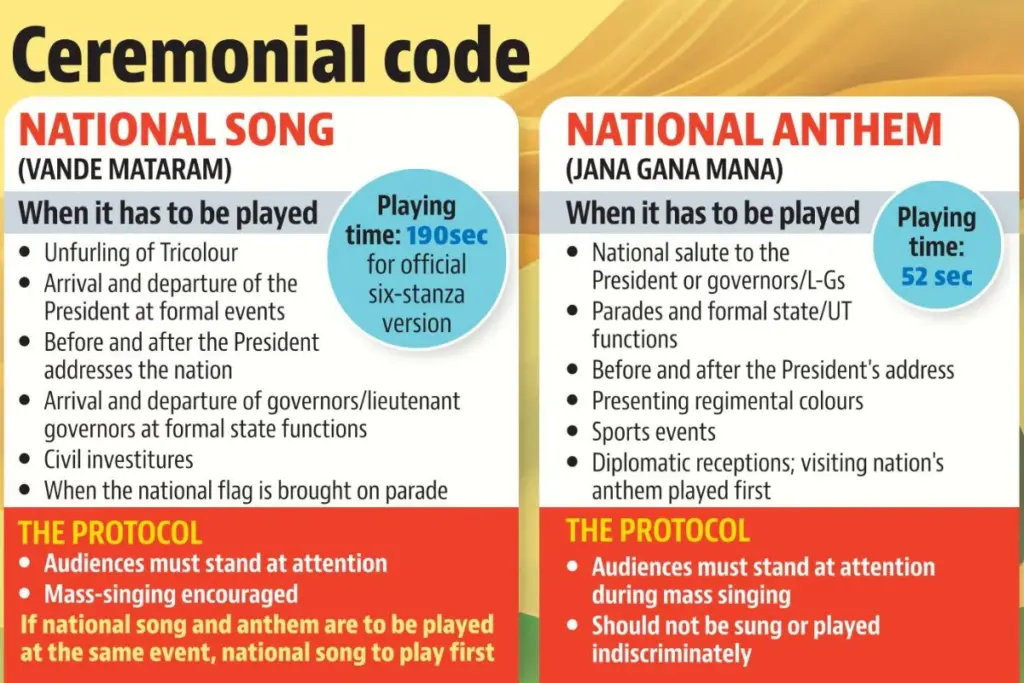
The order directs that Vande Mataram has to be played at the unfurling of the revered Indian tricolour. It should also be played at the arrivals and departures of the President at formal event and every time President addresses the nation.
It should also be played when the national flag of the country is brought on parade, during civil investitures and at the arrivals and departures of lieutenant governors/governors at formal state functions.
The playing time for the official six-stanza version should be 190 seconds. Audience must stand at attention and mass-singing must be encouraged.
Origins Of Vande Mataram
Vande Mataram was penned in 1875 by Bankim Chandra Chatterjee, initially as a two-stanza poem in Bengali and Sanskrit. In 1882, Vande Mataram was later expanded to six stanzas for the novel Anandamath.
Composed on November 7, 1875 (Akshaya Navami), Vande Mataram turned 150 in 2025.
The song personifies India as a divine mother. The first public rendition occurred at the 1886 session of the Indian National Congress when it was sung by Rabindranath Tagore. During the Indian independence movement, the song became the rallying cry. It was sung during protests, meetings and processions, defying the ban imposed on it by the Britishers on its public singing. It was endorsed by Mohandas Karamchand Gandhi as a source of unity, empowering youth and uniting diverse groups across different regions.
Vande Mataram was adopted on January 24, 1950 as the national song of India. Unlike the national anthem that focuses on brotherhood, the national song evokes maternal devotion and supreme sacrifice.
In 1937, Congress, under leaders including Jawaharlal Nehru and with Gandhi’s support, adopted only the first 2 stanzas as the “national song for public gatherings.” This decision aimed to avoid offending Muslim sentiments, as Nehru noted in letters that religious allusions might irritate minorities amid Partition tensions.
How Will Opposing Lobby React Now?
Several leaders such as Asaduddin Owaisi, Rahul Gandhi, Akhilesh Yadav, Mamata Banerjee and Abu Azmi have repeatedly spoken against the Vande Mataram. Some have cited religious objections while some treat the song as part of the BJP’s divisive tactics echoing “divide and rule” and question their freedom struggle credentials.


