

India EU FTA Deal: A landmark Free Trade Agreement (FTA) deal has been concluded by India and the European Union.

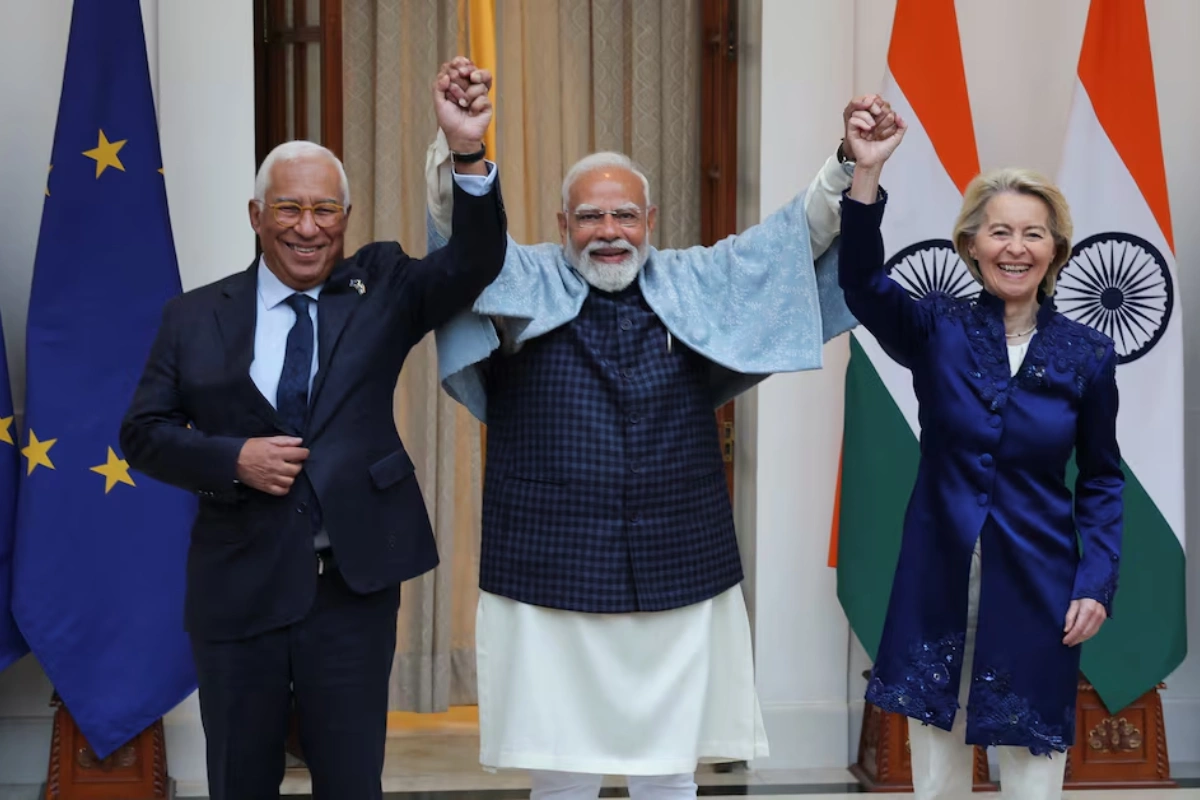
Ursula von der Leyen, the President of the European Commission, President of the European Council António Costa and Indian Prime Minister Narendra Modi have signed the “mother of all deals” today. This would reshape the economic trajectory of India and the EU while altering the geopolitical calculus of Beijing, Washington and Islamabad.
The FTA deal is likely to impact more than 2 billion consumers, setting a new template for how India and the EU engage with the global trading system.
Takeaways From The India EU FTA Deal
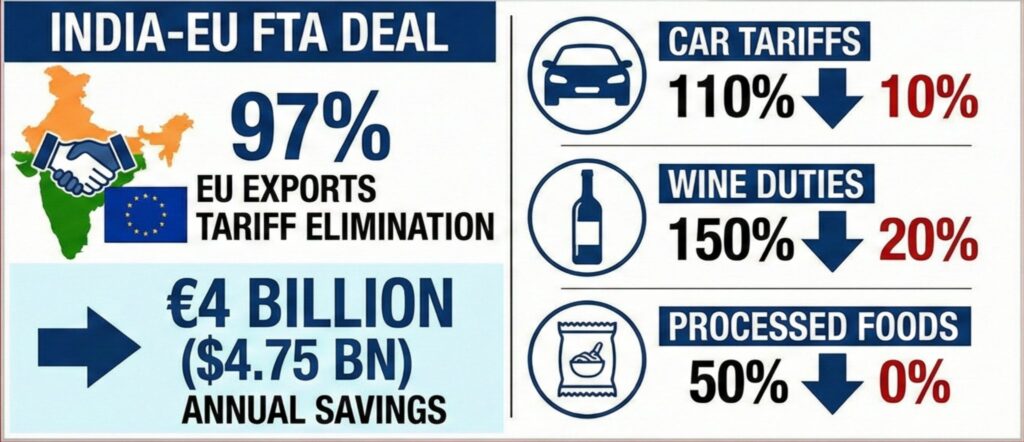
- Biscuits, chocolates, pasta, bread and other processed foods that were earlier facing approximately 50 percent import duty would now be moved to zero duty.
- Duties of approximately 45 percent on olive oil, margarine and other vegetable oils would be eliminated.
- Tariffs on fruit juices and non-alcoholic beer that were previously kept in the 30-50 percent band would be removed.
- Basic customs duty on European Wines that were previously as high as 150 percent would now be cut to 20-30 percent.
- Import duty on spirits such as whisky, vodka, rum and gin would be reduced from 150 percent to about 40 percent.
- Import duty on European beer would be reduced from 110 percent to 50 percent.
- Luxury and fully-built European cars that are presently facing 70 to 110 percent import duties would now be about 40 percent.
- Tariffs up to 44 percent on machinery and capital goods would be largely scrapped.
- Import duties up to 22 percent on EU chemical products would be largely eliminated.
- Import duties up to 11 percent on EU pharmaceutical products would be entirely eliminated.
- Tariffs on aircraft and spacecraft parts would be removed, taking them to zero duty.
- Around 90 percent of optical, medical and surgical equipment would become duty-free.
Why Washington, Beijing, and Islamabad Are Going Uneasy?
The EU-India deal is seen by Washington as reduced reliance on the US-centric trade architecture amid the aggressive tariff policies of US President Donald Trump and his “Buy American” rhetoric. Many in the US political circles worry that the integration of India and the European Union could significantly dilute the centrality of Washington in shaping global trade rules.
DON'T MISS
Beijing views the FTA between India and the EU as a limiting factor influencing its presence in the Indo-Pacific and South Asia. The deal threatens the Belt and Road‑driven outreach of China to Europe while undermining its narrative of being the indispensable economic partner from the region.
On the other hand, Islamabad fears that the EU-India deal could widen the already-huge economic gap between India and Pakistan, especially as Indian IT, textiles and engineering services would now gain privileged EU access.


%20deal%20has%20been%20concluded%20by%20India%20and%20the%20European%20Union.)