

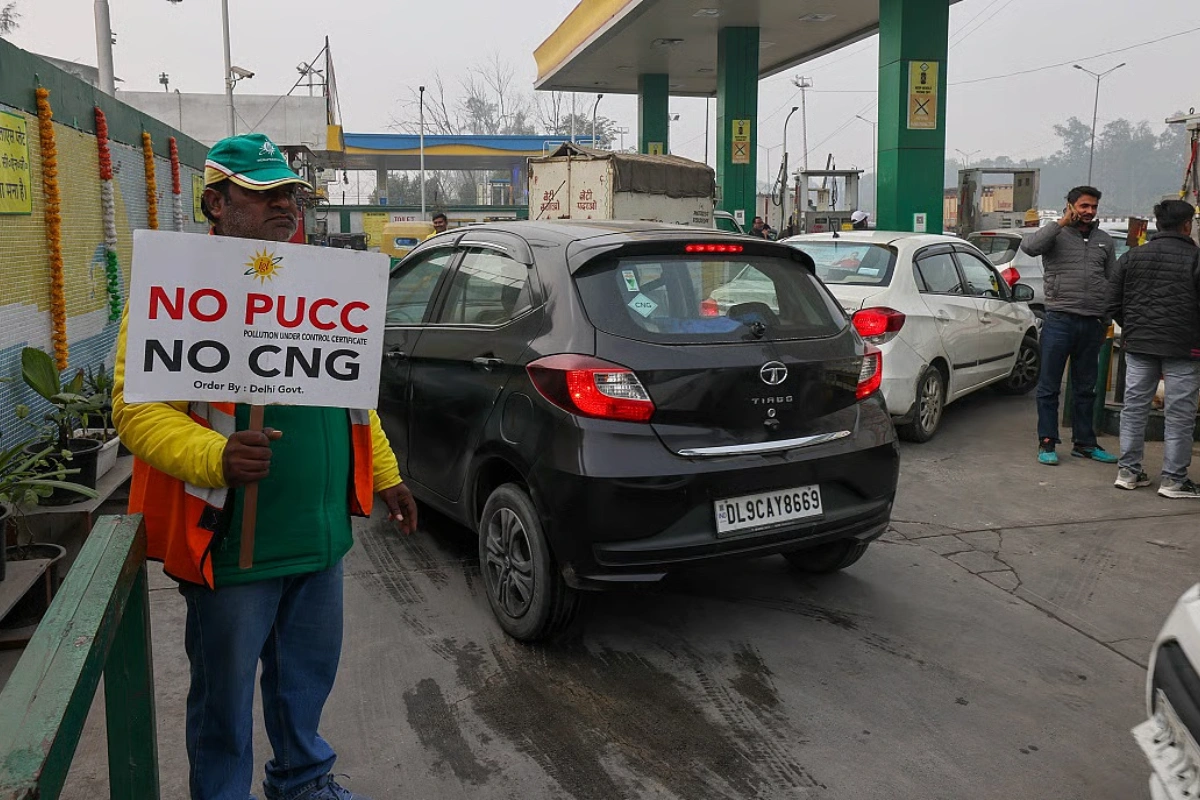
Delhi News: Delhi Chief Minister Rekha Gupta has announced that no petrol, diesel, compressed natural gas (CNG) and liquefied petroleum gas (LPG) vehicles starting today (April 23, 2026) will receive fuel at petrol pumps across the capital if they don’t have a valid pollution under control (PUC) certificate.
Delhi News-Implementation Process
The decision would be implemented as a permanent measure, instead of a short-time measure. The Delhi CM remarked that tackling air pollution in the capital city requires effective and firm interventions.
DON'T MISS
The state first rolled out the “no fuel without PUC” rule on October 25, 2026. However, the directive’s strict enforcement has stayed to be patchy till now as it was restricted to a few areas and short drives. City officials have cited a wide range of logistical hurdles, including the risk of congestion and the absence of seamless verification mechanisms at petrol pumps.
What Does It Mean For The Common Public?
The Delhi government’s order would impact end-of-life vehicles as pollution under control certificates cannot be issued to diesel vehicles that are older than 10 years and petrol vehicles that are older than 15 years.
All vehicles are required to carry a valid PUC certificate under Rule 115 (sub-rule 7) of the Central Motor Vehicles Rules, 1989 after one year of registration.
The state government’s order aligns with the revised Graded Response Action Plan (GRAP) that was issued by the Commission for Air Quality Management (CAQM).
The Logistical Hurdles
- Petrol pump staff is now expected to verify PUC certificates before dispensing fuel. This adds a new layer of responsibility to workers who are neither trained enforcement officers nor equipped with advanced verification tools.
- For seamless execution, pumps would need digital systems such as automated number plate recognition (ANPR) linked to a central database to instantly verify compliance. While such systems have been proposed, their coverage and reliability remain uncertain.
- Fuel denial could lead to disputes between customers and pump operators. Earlier enforcement efforts saw petrol pump owners requesting police protection due to fears of confrontation.
- Delhi’s geographical proximity to neighbouring states like Uttar Pradesh and Haryana creates a major loophole. Non-compliant vehicles could simply refuel outside Delhi, undermining the policy’s effectiveness.
Would the Capital City overcome these logistical hurdles to make the rule a success?


%20of%20the%20Central%20Motor%20Vehicles%20Rules,%201989.)