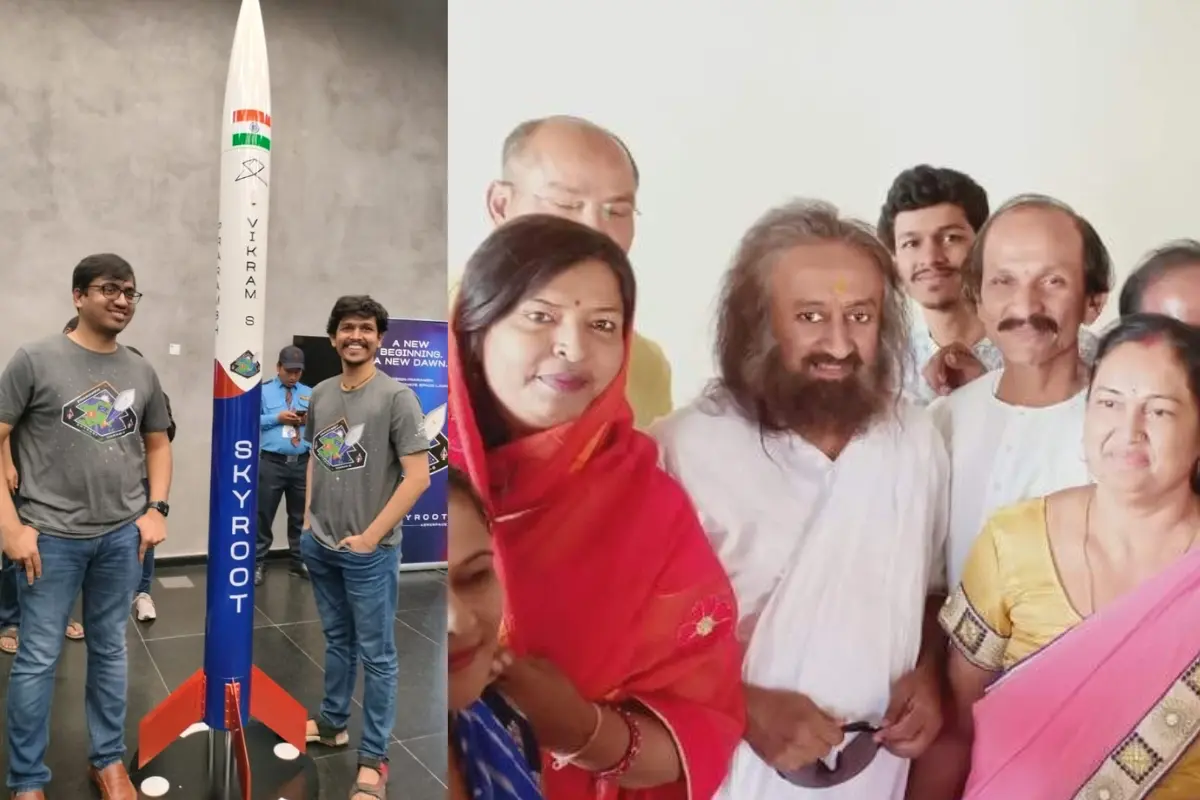
Dixit Khandelwal failed his mid-term mathematics paper in Class 7; years later, he’d work on the Vikram-1 launch, a landmark moment for India’s space startup journey
How preparation for a strong, focused mind in adulthood can begin early on
As more children grapple with academic pressure, competition, the need to multitask, and the challenges of growing up through emotionally confusing times, what can help them cope? Are there tools that can make the journey easier while helping them achieve their goals?
The ability to work with a restless mind can begin early, through practices that teach children to pause, focus and regulate their energy. And in this, Dixit’s story offers us hope.
You cannot dig a well after the fire has started. In other words, you cannot force half measures when youth are drowning in a mix of mental, emotional and material challenges to succeed in life. Dixit’s journey shows how life skills learned in childhood and embedded into one’s daily life can deeply benefit a person well into adulthood, when life gets tricky and messy too.
At a family gathering before his Class 10 exams, his cousins and sisters said, “We will pray to God that you pass.” Their remarks made him resolve to do well. “I will prove that I won’t fail,” he told himself.
And so he did. He secured 97% in mathematics.
Years later, just ten months of GATE preparation lay ahead of his final year of engineering. Friends who had prepared for a year longer laughed when he told them his target of 70. When his results appeared, his score read 70.44. “The real achievement was what happened between writing that number on the whiteboard and seeing it on my results sheet.”
The story of what made him so focused begins earlier, in Palanpur, Gujarat, where Dixit grew up. He describes himself as a child who was “extremely active and restless” and a “challenge to be disciplined.” When he was eight, his father enrolled him in The Art of Living’s Art Excel programme, now called Utkarsha Yoga, designed by global humanitarian and spiritual master Gurudev Sri Sri Ravi Shankar. The programme introduced him to yoga, breathing practices such as Sudarshan Kriya and meditation, offering ways to work with the energy and restlessness that made sitting still difficult.
At first, Dixit found it difficult even to close his eyes. Some mornings, his father had to wake him more than once to practise. Through school, football and karate held his attention more than textbooks. The principle behind focus, however, was simple. As Gurudev says, “If you love something, then focus comes naturally.”
After his Class 10 result, Dixit began practising Sudarshan Kriya every morning. He saw it as a tool for concentration and memory, calling it “the right weapon in the hands of a warrior.” By the time GATE preparation began, the practice had become part of his daily routine, much like brushing his teeth, one for dental hygiene and another for mental health.
DON'T MISS
Writing “I will score 70 marks” on his whiteboard, rather than measuring himself against classmates, came from a place he still finds hard to explain. “Something within me helped me make a decision at the right time,” he says.
A month-long study of 18 undergraduate students, compiled by the Sri Sri Institute for Advanced Research, reported 72% more correct responses and 67% fewer errors on tasks completed under stress after a month of Sudarshan Kriya practice. The researchers concluded that it “boosted attention, accuracy and stress resilience in students.”
Gurudev defines stress as “too much to do and too little time or energy. You cannot change the workload or the time you have; what you are left with is to increase your energy levels.” While preparing for GATE in ten months, Dixit says his practices gave him energy and clarity as he competed against classmates with a year’s head start.
At IIT Roorkee, Dixit pursued a master’s in nanotechnology, a field that was still new at the time. He found a group of fellow practitioners there, and together they organised Art of Living courses and volunteered alongside their studies. He describes those two years as a time when education and service “ran together.” “One was expanding my knowledge and curiosity,” he says, “while the other was helping me stay connected to people and to myself.”
A six-month internship in Singapore led him to a second master’s, in aerospace, at the Indian Institute of Space Science and Technology in Thiruvananthapuram, where he continued to volunteer whenever he could. He joined Skyroot Aerospace in 2021. His first contribution was the rocket simulation system for India’s first private suborbital rocket launch, Vikram-S, in 2022. With no coding background, he learned what the work required and wrote the software in C. “The software I built was used not only during the launch preparations but also to support several design decisions made by the GNC team,” he says.
His second contribution was to India’s first private orbital rocket launch, Vikram-1, on July 18, 2026. He was part of the guidance, navigation, and control (GNC) team. He helped design algorithms determining how the vehicle should respond. He tested the software and rocket hardware together before flight.
Skyroot invited him back to witness the Vikram-1 launch, although he had already joined another company. He stood with the team, watching it climb-a moment he says remains “very special.”
Whenever he feels stuck, he remembers the gift of Sudarshan Kriya and the spiritual training he received through his childhood association with The Art of Living. His reassurance comes from his Guru’s comforting words. Gurudev often says, Dixit recalls: ‘I am there; you don’t have to worry.’