

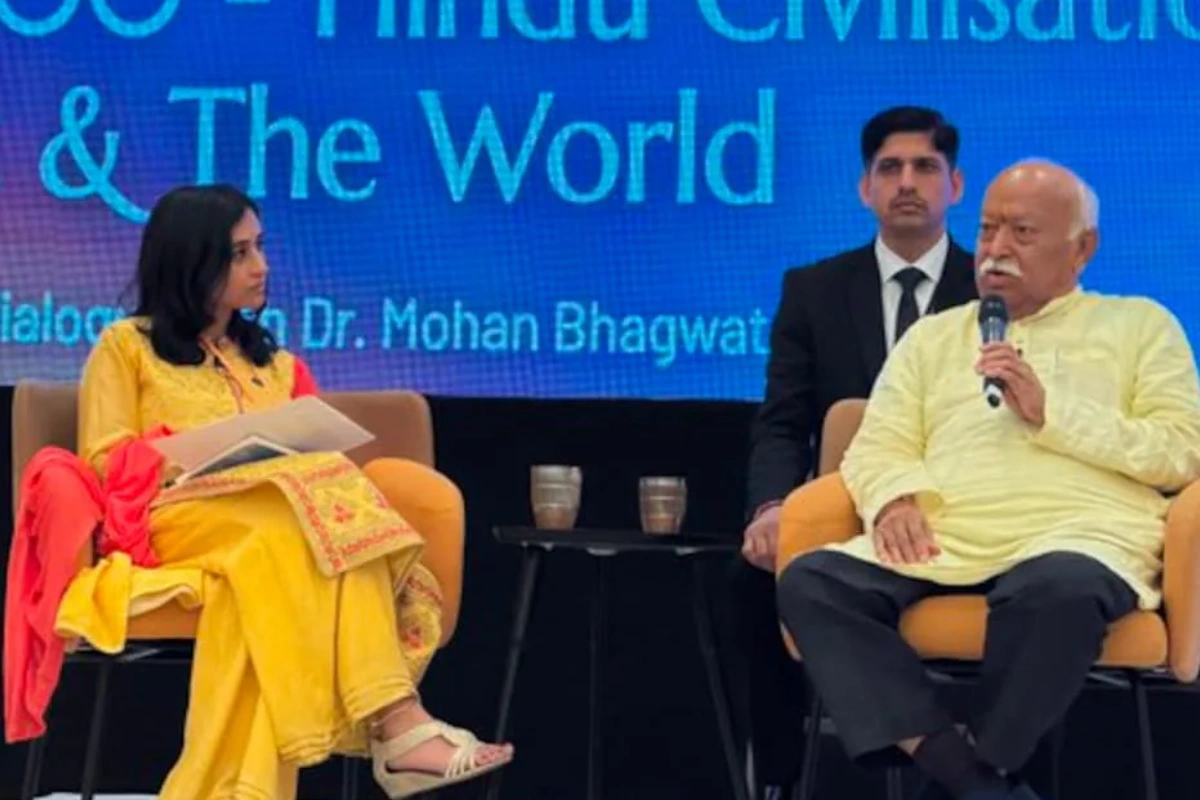
Mohan Bhagwat: The term “Shuddha Saatvika Prem” has been one of the central themes of the speech delivered by the RSS leader Mohan Bhagwat in London recently, when he called it the basic principle of the organization. Bhagwat mentioned the term when he was rejecting the statement that hatred is the principle of RSS activity.
What is ‘Shuddha Saatvika Prem’?
“Shuddha Saatvika Prem” is a Sanskrit term that may be translated as pure and noble love. The explanation of the term provided by the RSS leader consists in the fact that the term means “apanapan,” the sense of belonging and oneness with others. As Bhagwat explained, the sense of belonging to somebody should extend to family, community, society, and humanity and the relations between people and nature as well.
DON'T MISS
Why Did Bhagwat Mention It in His London Speech?
Bhagwat mentioned the term “Shuddha Saatvika Prem” in his London speech while answering criticism of the RSS ideology. According to him, the statement about hatred is the principle of RSS activity contradicts his own understanding of it.
‘Apnapan’ Concept
The concept of apnapan, or a sense of belonging, was yet another important aspect of Bhagwat’s speech. This concept could also be viewed in connection with the overall philosophy expounded by Bhagwat and especially with the concept of diversity versus unity in Hinduism as an acceptance of diversity and respect for it rather than separation because of it.
Unity and Diversity
Bhagwat also touched upon the question of unity and diversity. His view of this matter is that unity does not have to mean uniformity. Diversity is seen by him as natural and it is possible to accept different forms and traditions as long as there is an acceptance of what is being viewed as an underlying unity of existence.
What Does It Mean for RSS Philosophy?
Mohan Bhagwat: According to Bhagwat’s statements, the Shuddha Saatvika Prem philosophy is a philosophy of belonging and social connections as well as respect for diversity. In his London speech, Bhagwat put these ideas into a wider context of civilisation, Hindu society, nature, and RSS self-perception.


