


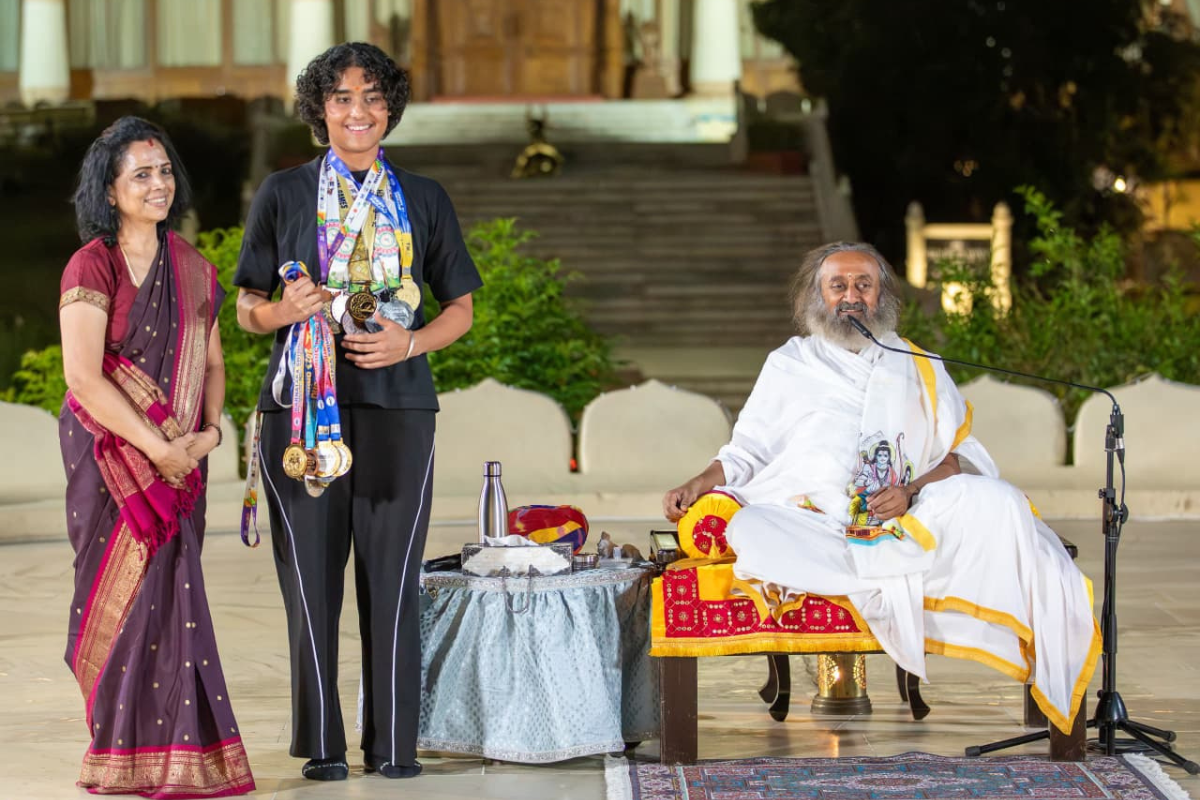
“This year she has won 117 medals.” At once, heads in the audience turned toward this tall, curly-haired 18-year-old girl who stood quietly with a cascade of medals around her neck. Beside her, a graceful middle-aged woman held another heap of medals in her hands, displaying them to Gurudev Sri Sri Ravi Shankar and the gathering at The Art of Living International Centre.
The youngster was Vihitha Nayana Loganathan of Bengaluru.
Today, she is the fastest female backstroker in India, a swimmer rewriting records. But behind the glitter of gold, silver, and bronze lies a story of fear, collapse, rebuilding, grit, and, most importantly, intuition.
When Covid-19 Changed Everything
Vihitha had been winning scores of medals at the Junior Nationals. A promising young talent, coaches at the Basavanagudi Aquatic Centre (BAC), Bengaluru, were confident she would build a successful career, while her rivals never took her lightly in the water. While things were looking bright, COVID-19 upended everything.

Swimming pools were closed. Her regular training had stopped, and her swimming routine was totally disrupted for an indefinite period. Swimming, especially professional swimming, unlike most other sports, cannot survive long, indefinite pauses.
“When I returned to the water, I wasn’t the same,” says Vihitha.
Filled with self-doubt, fear of failure, and self-blame, as she stepped up for her race, the sound of an electronic beep signalling the start would make Vihitha shudder in panic.
She had already been ruling swimming pools at different national-level competitions in India. Yet, sweating palms, racing heartbeats, and trembling feet became her permanent nemeses before every competition.
“I would cry in solitude before the start of a competition,” Vihitha recalls. “I had never experienced that kind of panic before entering the pool,” she adds, “I couldn’t focus on the race and started losing matches.”
What concerned her parents wasn’t her making it to the podium. “It was the drastic change in her personality,” shares her father, Loganathan.
The once cheerful Vihitha was withdrawing into a cocoon. The pressure of expectations, failure, and loneliness began building quietly inside her. Vihitha adds, “I would choose to sit on the front bench in my classroom just to avoid conversations with my classmates.”
There is a teen mental health crisis simmering under the surface that demands a conversation today. As per the latest data, around 7.3% of young people (18–29) experience mental health morbidity, and over 1 in 5 adolescents (10–19) is battling issues like depression, anxiety, and severe stress.
“I could see my daughter bearing an unfathomable pain silently,” shares her father, “I couldn’t allow it to go further, and I encouraged Vihitha to attend the Intuition Process (IP) by The Art of Living.”
The Turning Point
“During the program, she would sit in one corner and hardly speak. The only thing she told me was that she used to swim regularly,” recalls Latha Kannan Iyer, Vihitha’s Intuition Process teacher.
Although her father had been associated with The Art of Living for a while, she did not make much of it initially.
DON'T MISS
But what drew her attention eventually was the atmosphere. “It was unlike anything in my classroom or the swimming pool,” smiles Vihitha. “For the first time, I didn’t feel judged.” In the program, Vihitha would go on to learn specific breathing techniques, meditation, silence, and team activities that would empower her to tap into her intuitive abilities, heighten her focus, and, most importantly, bring back her confidence.
The global spiritual master and humanitarian who designed the gift of Intuition Process, Gurudev Sri Sri Ravi Shankar explains intuition as having “the right thought at the right moment.”
When children are stress-free, clear, and focused, they have natural access to this vast consciousness beyond time and space, and that is what The Art of Living’s Intuition Process helps children get access to.
Intuition Or Magic?
Just as she was instructed, Vihitha continued to practice the IP techniques for 40 days. It helped that her mom would give her constant reminders. But it was the changes she observed in herself that became her greatest motivation.
Now, instead of feeling overwhelmed, Vihitha began sitting quietly before a race. She would close her eyes. She would practice deep breathing, and then she would visualise the entire race. “It happened before a 50-metre backstroke race. ‘29.88’, this number flashed in my mind. I brushed it aside and finished the race. When I looked at the LED scoreboard, it was ‘29.88 sec’,” narrates Vihitha.
“Vihitha would tell me that while swimming, she could almost sense her opponents. She knew who was ahead, what was happening in the race, and what she needed to do,” shares Latha.
Reclaiming The Podium
Soon, Vihitha turned the tables on her self-doubt and regained her winning streak. She has represented India at the Bahrain Asian Youth Games, the Asian Championships in Ahmedabad, and the World Junior Championships in Romania. She has broken national records, won a gold medal at the National Games, and is now the reigning queen of backstroke in India. She has won around 150 medals in the last 3 years.
The Impact Beyond The Pool
As an international-level swimmer, Vihitha never had enough time to study. By the time she returned home after practice, she would be exhausted. She chose science in her higher secondary, including biology, a subject that comes with plenty of diagrams, complex scientific names, and detailed definitions. Now, after doing the IP, she started developing a photographic memory. She could visualise the questions before exams, she says.
For a young athlete trying to balance sport and studies, this changed the game for her in academics. Slowly, she began scoring better and got admission into a reputed institution in Bengaluru to study Sports Science.
But perhaps the greatest change had nothing to do with laurels in sports and academics. The greatest change was a shift in her perspective towards facing failure. The IP did not just return her confidence to win, but it made her self-assured, which went beyond the results of the games.