Home Blog Page 166

“This Universe Can’t End Here” Sequel Buzz Around Ranveer Singh Dhurandhar 3 Intensifies, Rakesh Bedi Spills the Beans

Ranveer-Singh

Ranveer Singh: The internet isn’t ready to move on – and honestly, neither is the Dhurandhar fandom. Even as the makers draw a firm line under the franchise, fresh comments from Rakesh Bedi have reignited conversations around a possible Dhurandhar 3. But the reality? It’s more nuanced than the hype suggests.

What Rakesh Bedi Really Revealed

In a recent interview, Rakesh Bedi addressed the ongoing speculation. His stance was clear—a direct third instalment is unlikely. According to him, the journey of Hamza Ali Mazari, played by Ranveer Singh, has reached a natural conclusion.

However, he didn’t completely shut the door. Instead, he hinted that Dhurandhar has evolved into a strong cinematic universe, leaving room for:

  • Spin-offs
  • New characters
  • Alternate storylines

And that subtle hint is exactly what fans are holding onto.

Makers Stand Firm: Story Ends with The Revenge

Director Aditya Dhar has consistently maintained that Dhurandhar 2: The Revenge was crafted as the final chapter. Backing this, casting director Mukesh Chhabra recently dismissed viral rumours about a third film, calling circulating post-credit clips fake and unofficial.

Why Fans Still Want More

Even though the ending was a “full stop,” the demand won’t go away:

  • The spy twist involving Jameel Jamali became a hot topic of conversation.
  • The size and the way the story was told made the world seem bigger than life.

There are a lot of hashtags on social media, like #Dhurandhar3. Fans want more than just a sequel; they want the universe to grow.

Box Office Adds to the Fire

The numbers only make the case stronger. Dhurandhar 2 has made more than ₹1,755 crore around the world, making it one of India’s biggest hits. It seems brave to walk away after that kind of success, but it also makes sense.

Is it better to make a spin-off than a sequel?

A spin-off could do the following instead of stretching Hamza’s arc:

  • Look into side characters like Jameel Jamali.
  • Add new missions to the same world
  • Keep the brand going without changing the original story
  • The creators seem determined to end the story at its peak right now.

TCS Nashik Case: From Online Chats to Real-Life Fallout, Conversion and Harassment Probe Reveals Complex Digital Connection, Check

TCS-Nashik-Case

TCS Nashik Case: The ongoing investigation in the Tata Consultancy Services Nashik case has uncovered a deeply complex web of allegations involving workplace harassment, religious influence, and extensive use of social media platforms. 

How Online Chats Triggered the Investigation?

According to the police probe, the case gained momentum after concerns emerged about employee interactions on social media and messaging platforms. Investigators found that accused individuals allegedly used platforms like WhatsApp, Instagram, and Facebook to communicate with victims in ways that later formed part of the harassment allegations. Reports suggest that these digital conversations were not isolated incidents, but part of a broader pattern being examined by authorities through recovered chat logs and electronic devices.

What the investigation reveals so far?

The Nashik police have registered multiple FIRs related to serious allegations, including harassment and coercion within the workplace. The probe has also explored claims of influence and pressure linked to personal beliefs and workplace interactions. Officials have stated that the case is being treated as a multi-layered investigation, where digital communication plays a key role in understanding how the alleged incidents unfolded over time.

Digital Evidence at the Center of the Case

One of the most important aspects of the investigation is the role of social media and messaging apps. Authorities are analyzing chats, images, and call records to establish patterns of behavior and verify complaints. The use of digital platforms has made the case more complex, as investigators attempt to distinguish between personal conversations and alleged misuse or harassment.

Rashid Khan Net Worth 2026: Afghanistan Cricketer’s Whopping Multi-Million Dollar Empire Through Cricket and Endorsements Explored

Rashid-Khan-Networth

Rashid Khan Net Worth: Rashid Khan is a top Afghan cricketer with an estimated net worth of ₹30–120 crore in 2026. He earns mainly through IPL with the Gujarat Titans, global T20 leagues, endorsements, and international cricket. 

What is Rashid Khan’s net worth in 2026?

Rashid Khan Net Worth: As of April 2026, Rashid Khan’s estimated net worth is around ₹30 crore to ₹120 crore ($4–13 million). He is considered one of the highest-paid cricketers in global T20 cricket, thanks to his IPL contracts, international matches, and franchise league earnings.

What is Rashid Khan’s salary?

Rashid Khan earns a major part of his income from the IPL (Indian Premier League). The Gujarat Titans retain him for approximately ₹15–18 crore per season. Overall, his IPL career earnings have crossed ₹85 crore+, making him one of the top earners in league history.He also earns an annual salary of around ₹72.82 lakh from the Afghanistan Cricket Board through international cricket contracts.

What are Rashid Khan’s Sources of Income?

Rashid Khan’s income comes from multiple streams:

  •  IPL salary (Gujarat Titans)
  •  Global T20 leagues like BBL, PSL, and MLC
  •  International cricket matches
  •  Brand endorsements like Puma, Red Bull, Monster Energy, and more

 What Properties Does Rashid Khan Own?

Rashid Khan reportedly owns luxury properties in Afghanistan, especially in Jalalabad. Despite his global fame, he maintains strong roots in his home country and invests in real estate there.

How Many Vehicles Does Rashid Khan Have?

Rashid Khan is known to own luxury cars, including a Range Rover. His car collection is modest compared to that of other cricketers, reflecting his simple and grounded personality.

What is Rashid Khan’s lifestyle like?

Despite being a multi-millionaire, Rashid Khan is known for a simple and humble lifestyle. He avoids excessive luxury and focuses more on cricket and fitness. He is also involved in charity work through his foundation, supporting social causes in Afghanistan.

US Israel Iran War: US Ship Seizure Backfires! Drone Storm Strikes American Fleet, Is Middle East In Crisis Mode Yet Again?

US Israel Iran War
Image Credit: Google

US Israel Iran War: The Islamic Republic of Iran has officially rejected fresh ceasefire negotiations with the United States of America, citing the unrealistic demands of US President Donald Trump. Oil prices rose 6 percent after Iranian ship was seized by US Navy in the Gulf of Oman after the vessel tried to bypass the American blockade.

On Monday, West Texas Intermediate jumped 7.5 percent to trade at $90.17 a barrel. Meanwhile, Brent Crude rose 6.5 percent to $96.27 a barrel.

US Israel Iran War-Iranian Ship Seized

US President Donald Trump announced that the USS Spruance fired at the Iranian vessel to damage its engine room before the US Marines took control of the ship.

In a statement, Iran’s top Joint Military Command remarked that Tehran would soon retaliate against the maritime and armed robbery by the United States Military. Earlier, Trump accused Tehran of violating the ceasefire after Iran attacked two Indian ships.

Iran Not To Pay For Home Repairs

In another development, Tehran has decided to step back from previous promises to compensate homeowners of the country whose properties got damaged in joint strikes by Israel and the United States. This has triggered massive uproar among residents who expected the administration to take complete responsibility for rebuilding their residential and commercial properties.

India Issues Emergency Contact Numbers Of Embassies

Meanwhile, India has issued a list of emergency contact numbers of its embassies to help Indians in the Middle East.

The numbers are as follows: Ramallah, Palestine: +970 592916418, Saudi Arabia (Riyadh): +966 11 4884697 / 800 247 1234 (Toll free), Saudi Arabia (Jeddah): +966 126648660 / +966 12 2614093, Iraq: +964 771 651 1185 / +964 770444 4899, Israel: +972 54 7520711 / +972 54 2428378, Jordan: +962 770 422 276, Kuwait: +965 65501946

Lebanon: +961 76860128, Oman: +968 98282270 (WhatsApp) / 80071234 (Toll free) Qatar: +974 55647502, Bahrain: +973 39418071, Iran: +98 9128109115 / +98 9128109102 / +98 9128109109 / +98 9932179359, United Arab Emirates: +971 543090571 (WhatsApp) / 800 46342 (Toll free).

Bhoot Bangla Box Office Collection Day 3 Update: Despite Ranveer Singh’s Dhurandhar 2, Occupancy Rates Hint at Bigger Success Ahead! Check Figures

bhoot-bangla

Bhoot Bangla Box Office Collection Day 3: The box office is currently witnessing a strong clash between Bhoot Bangla and Dhurandhar 2: The Revenge, where both films are showing impressive but very different performance trends. 

Bhoot Bangla Day 3 Box Office Collection

Bhoot Bangla Box Office Collection Day 3: Bhoot Bangla collected ₹23.00 Cr net on Day 3, marking a 21.1% growth compared to Day 2’s ₹19.00 Cr. The film maintained a stable audience turnout across 11,682 shows. With this, its total India net collection stands at ₹58.00 Cr, while the India gross has reached ₹69.37 Cr so far. Overseas, the film earned ₹7.00 Cr on Day 3, taking its total overseas gross to ₹26.50 Cr. This pushes the worldwide gross collection to ₹95.87 Cr. The improving occupancy trend suggests growing audience acceptance and positive word-of-mouth, indicating potential for stronger performance in the coming days.

Dhurandhar 2 Day 3 Box Office Collection

On the other hand, Dhurandhar 2: The Revenge starring Ranveer Singh, delivered a massive Day 3 collection of ₹113.00 Cr net, showing a 40.0% jump from Day 2’s ₹80.72 Cr . The film continues its strong run across 20,917 shows, taking its total India net collection to ₹339.27 Cr and India gross to ₹406.51 Cr.  In overseas markets, it earned ₹52.85 Cr on Day 3, pushing its total overseas gross to ₹149.35 Cr . This takes the worldwide gross collection to a staggering ₹555.86 Cr.

Occupancy Trend Hints at Bhoot Bangla’s Long-Term Potential

Even though Dhurandhar 2: The Revenge starring Ranveer Singh is clearly dominating the box office in terms of collections, Bhoot Bangla is showing a different but interesting trend. The film is witnessing steadily improving occupancy rates, meaning more audience footfall in theatres with each passing day. 

DME Media School Successfully Concludes ICAN 8 with Global Participation and Academic Excellence

DME Noida

Delhi Metropolitan Education (DME) successfully concluded the 8th International Conference ICAN, a two-day global academic event centred on the theme “Media for People and Planet: Communication and Innovation towards Sustainable Development Goals 2030.” The conference brought together academicians, researchers, media professionals, and students from across India and abroad to deliberate on the critical role of media and strategic communication in achieving the Sustainable Development Goals (SDGs) by 2030.

The conference commenced on April 16 with an inaugural session held at the Nelson Mandela Auditorium, DME, graced by Hon’ble Mr. Justice Bhanwar Singh, Director General, DME, whose address set an inspiring tone for the event. The occasion was further enriched by the presence of Mr. Radhe Shyam Rai, Managing Editor, Bharat Express News Network, Chief Guest in Inaugural Plenary, whose insightful remarks highlighted the evolving role of media in fostering inclusive growth and sustainable development. Prof. (Dr.) Komal Vig, Director, DME, also addressed the gathering, emphasising the importance of academic dialogue in shaping a sustainable future.
The inaugural plenary session featured eminent speakers including Prof. (Dr.) Surbhi Dahiya, from IIMC New Delhi, Prof. (Dr.) Kulveen Trehan, IP University, Mr. Shishir Sinha, senior Journalist and Prof. (Dr.) Ambrish Saxena, South Asian University who shared valuable perspectives on the intersection of media and sustainability.

The conference, organised under the support of Hon’ble Vice Chairman, Mr. Aman Sahni, and Vice Chairwoman, Ms. Nishtha Sahni was thoughtfully designed by Dr. Parul Mehra, Head of DME Media School and Convenor, ICAN, along with Dr. Yamini Khullar, Convenor, ICAN. Co-Convenors Dr. Divya Rastogi and Ms. Chetna Sharma played a significant role in organising and executing the sessions.
ICAN 8 received over 80 research papers from across the globe, with participation from countries including Sri Lanka, the United States, Nigeria, Bangladesh, Bhutan, China, and the United Kingdom. Day 1 concluded with a plenary session featuring distinguished international speakers such as Prof. Jatin Srivastava, Dr. Ngozi Okpara, Dr. Anne F. MacLennan, and Prof. (Dr.) Wajiha Raza Rizvi, among others.
Day 2 of the conference further enriched the academic experience with the presence of esteemed guests including Mr. A. Rajiv Tickoo, Development Communication Expert, DME; Mr. Ajit Kumar Singh, AGM-Marketing, IOTA Water; and Dr. Kanwaljit Singh, Associate Professor, Himachal Pradesh University. Their insights contributed meaningfully to discussions on communication strategies for sustainable development.

A major highlight of the second day was the successful conduct of four technical online sessions, where researchers and academicians presented their papers across diverse themes such as environmental communication, social justice, gender equality, and strategic media practices. These sessions facilitated dynamic knowledge exchange and highlighted innovative research contributions.
The conference concluded with a valedictory ceremony, marking the successful culmination of ICAN 8. The ceremony reflected upon the key discussions and outcomes of the conference, celebrating the contributions of participants, organizers, and speakers. It underscored the importance of continued academic collaboration and the role of media in driving positive global change.

ICAN 8 stands as a testament to DME’s commitment to fostering academic excellence, global dialogue, and meaningful engagement on issues of sustainability. The conference not only provided a platform for scholarly exchange but also reinforced the transformative potential of media in shaping a better and more equitable world.

Out of 28 LMT Wheat arrival in mandis, more than 24 LMT stands procured: Lal Chand Kataruchak

Punjab News

The Food, Civil Supplies and Consumer Affairs Minister Lal Chand Kataruchak here today at Dana Mandi took stock of the procurement operations and said that the procurement of Wheat continues uninterruptedly in the mandis of the State and till now more than 24 Lakh Metric Tonnes (LMT) produce out of 28 LMT arrival, has been procured.

Initiating the procurement of the produce of farmer Jaila hailing from village Basti, the Minister accompanied by MLA Jasvir Singh Raja Gill, said that robust arrangements have been made in the mandis regarding procurement to ensure the farmers encounter no difficulty in selling their crops.

As per the Minimum Support Price (MSP) fixed at Rs. 2585 Per Quintal, an amount of Rs. 647 Crore has been credited into the accounts of farmers. The State Government is fully committed to procure every single Grain produced by the farmers and as part of this commitment, payments are being made to the farmers within 48 hours of the procurement with lifting also picking up pace.

The Minister while directing the concerned officers of the procurement agencies to make sure that the farmers encounter no hassle in the mandis, divulged further that the necessary arrangements with regard to the Bardana, Labour and Transportation have been ensured in the mandis. He also appealed to the farmers to desist from burning wheat stubble and instead go for managing the stubble in the fields itself through usage of the machinery made available by the Agriculture Department.

Regarding making good the losses caused to the crops in the past few days due to the unseasonal rain, the Minister said that specifical girdawari has been ordered and the State Government would make good the loss suffered by the farmers.

The MLA Jasvir Singh Raja Gill said that the Punjab Government would ensure hassle free procurement and prompt lifting of the produce like previous year. He also said that the State Government led by the Chief Minister Bhagwant Singh Mann has always catered to the interests of farmers and is ensuring timely payments after the procurement of Wheat. He also gave instructions to the administrative officials to ensure timely procurement in the mandis.

In Hoshiarpur, 78 mandis have been set up out of which 65 are permanent while the rest 13 are temporary. The District expects 316000 MT of Wheat arrival.

Among others present on the occasion included the SDM Lovepreet Singh, Chairman Market Committee Rajwinder Singh, Secretary Market Committee Harpreet Singh, Deputy Director Food supply Rajnish Kumari and the DFSC Preetkamal Sood.

Bill against beadbi of Sri Guru Granth Sahib Ji becomes law after Governor’s assent, CM Bhagwant Singh Mann Thanks Waheguru & Sangat

CM Mann

Punjab Chief Minister Bhagwant Singh Mann on Sunday announced that the bill passed in the Punjab Vidhan Sabha against ‘beadbi’ (sacrilege) of Sri Guru Granth Sahib Ji has now officially become law after receiving the assent of the Governor, marking a significant legislative step towards safeguarding the sanctity of the holy scripture.

In a post on X, CM Bhagwant Singh Mann said, “The bill passed in the Vidhan Sabha against the beadbi of Sri Guru Granth Sahib Ji has been signed by the Governor, Gulab Chand Kataria. Now this bill has become law. I am deeply grateful to Waheguru for entrusting this humble servant with such a service. My heartfelt thanks to the entire Sangat.”

Punjab Cabinet Minister Harjot Singh Bains termed the development a “highly auspicious and historic moment” for all. He said, “This is a highly auspicious and historic moment for all. The bill passed on April 13 on the occasion of Vaisakhi has now come into force as the Sri Guru Granth Sahib Ji Satkar Act, 2026. I congratulate not only Sikhs but people of all religions who hold Sri Guru Granth Sahib Ji in reverence, as this law reflects the collective faith and sentiments of millions.”

Cabinet Minister Baljeet Kaur stated, “This is a fortunate and historic day. This law will act as a strong deterrent against those who committed acts of beadbi with the intent to create division in society. The Mann government has delivered what previous governments failed to achieve despite claiming to be protectors of Panthic values. This law will ensure strict punishment and promote communal harmony by preventing any attempts to spread hatred in the name of religion.”

MLA Dr. Inderbir Singh Nijjar stated, “This is a historic day for Punjab. The bill was passed unanimously in the Vidhan Sabha and has now received the Governor’s approval. I credit CM Bhagwant Singh Mann for presenting the bill with courage and sincerity, and I am hopeful that the strict provisions in the law will put a complete stop to incidents of beadbi, as offenders will now think multiple times before committing such acts.”

MP Malvinder Singh Kang said said, “This law marks a significant step in addressing a long-pending demand of Sikhs across the world for strict punishment against beadbi. It will instill fear among those who attempt such acts and ensure justice. I thank Waheguru and the Mann government for translating the sentiments of Punjab’s people into a strong legal framework.”

AAP Punjab Chief Spokesperson and MLA Kuldeep Singh Dhaliwal expressed immense happiness, calling it a proud moment for Sikhs across the globe. He said, “This is a proud moment for Sikhs across the globe. This law will ensure better protection for Sri Guru Granth Sahib Ji. I congratulate the Sikh community worldwide and thank the Chief Minister and the Governor for making this possible.”

Echoing similar sentiments, party leaders said that the enactment of this law sends a clear message that beadbi will not be tolerated under any circumstances and added that the legislation will safeguard religious harmony and uphold the dignity of all sacred texts.

‘We just kept going’: A Punjab family’s journey through cancer, debt, fears, and a government health scheme

Punjab news

The road from Patiala to Sangrur is not very long on a map. But for one man, it stretched into something far heavier, measured not in kilometres, but in fear, silence, and the weight of a son watching his mother slip away.

Each trip marked another hospital visit. Another set of test results. Another bill to be paid.
For Gurpinder Jeet Singh, a driver in Patiala, recent months have meant repeated hospital visits, rising medical bills and uncertainty over his mother’s health.

His 65-year-old mother, Baljit Kaur, was diagnosed with uterine cancer after initially experiencing weakness and loss of appetite. “She gradually stopped eating. Even drinking water became difficult,” he said.

After visits to local clinics, she was referred to Rajindra Hospital, where tests confirmed the diagnosis. Treatment began soon after, but costs mounted quickly.

“In the first few weeks, we spent over ₹60,000,” Gurpinder said. “As a driver, arranging more money was difficult. I started thinking about loans and selling belongings.”

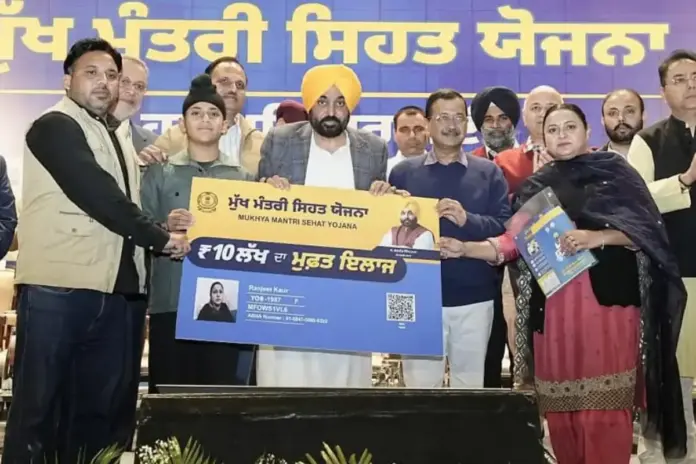
Doctors advised chemotherapy followed by surgery, depending on her response. As consultations continued across hospitals, Gurpinder learned about the Mukh Mantri Sehat Yojana.

“Someone at the hospital mentioned it. I didn’t believe it at first, but I checked and completed the formalities,” he said.
After verification, the family was enrolled under the scheme, which provides cashless treatment across various government and empanelled private hospitals. Health officials said the programme aims to expand access to treatment across income groups, requiring only basic identification for enrolment.

Following registration, Baljit Kaur continued chemotherapy and later underwent surgery. Doctors noted that uninterrupted treatment was crucial. Doctors agree that when care isn’t delayed due to financial constraints, outcomes improve. She underwent around 12 chemotherapy sessions before an eight-hour surgery. She remained in the ICU on ventilator support for several days before stabilising.
“She was in the ICU for days. We just waited outside,” Gurpinder said.

She was later discharged after further observation and is now recovering at home, with gradual improvement, family members said.

Gurpinder estimates the total cost of treatment, including chemotherapy, surgery, ICU stay and medicines, would have been ₹8–10 lakh. Most expenses were covered under the scheme, though some medicines were purchased separately due to non-availability at the hospital.

“The biggest relief is that we didn’t have to stop treatment because of money,” he said.
For the family, the experience highlights both the strain of serious illness and the role of government healthcare support in easing financial burden.

Today, Baljit Kaur is back home, recovering slowly. The treatment, worth almost more than ₹8 lakh, was covered. Chemotherapy. Surgery. ICU. Medicines. Even hospital stay. Gurpinder still paid for a few medicines outside, those that were not available at the hospital, but the mountain he once faced had, somehow, been lifted.

Baljit Kaur is now recovering. She eats a little more. Speaks a little more. Lives a little more.
The journey from Patiala to Sangrur is still the same distance.

But for this family, and probably many more, it became the road where despair met dignity, relief, and the return of hope.

Bhagwant Mann Govt’s anti-beadbi bill becomes law with Governor’s assent, ends era of weak laws & political shielding: Harpal Singh Cheema

Harpal Cheema

The Bhagwant Mann Government has officially implemented the ‘Jaagat Jot Sri Guru Granth Sahib Satkar Amendment Bill’, with the Governor of Punjab granting assent to the legislation mandating life imprisonment for those found guilty of desecration of Sri Guru Granth Sahib.

Addressing a press conference at Punjab Bhawan on Sunday, Cabinet Minister Advocate Harpal Singh Cheema described the move as a decisive step to preserve communal harmony and uphold the sanctity of religious scriptures. “The history reflects a troubling pattern where incidents of beadbi occurred during the tenure of the Akali-BJP government, specifically citing the 1986 Nakodar incident and the 2015 Bargari and Behbal Kalan cases,” he added.

The Cabinet Minister added that successive regimes failed to ensure justice, saying, “Despite the formation of various commissions and Special Investigation Teams under previous governments, key evidence such as Action Taken Reports went missing and investigation files gathered dust, leaving the culprits and conspirators shielded from the law.”

Highlighting the shift since 2022, he said, “The Bhagwant Mann Government has worked tirelessly to accelerate investigations that remained stalled for decades. For the first time, high-profile figures who previously enjoyed political protection were forced to seek anticipatory bail from courts.” Reaffirming the government’s commitment, Minister Harpal Singh Cheema stated that every perpetrator, irrespective of social or political stature, will be brought to justice.

Explaining the provisions of the law, Minister Harpal Singh Cheema said, “The newly enacted law is designed to be comprehensive and watertight, leaving no loopholes for offenders to escape justice. The act not only targets those who physically commit acts of beadbi but also holds the masterminds and conspirators accountable.”

He further added, “Furthermore, the legislation addresses the common defense of ‘mental instability’ used to evade prosecution. Under the new provisions, if an individual under the care of a guardian commits such an act, the guardian or custodian can also be held liable for negligence, ensuring a higher level of accountability for the protection of the holy scripture.”

Concluding his address, Minister Harpal Singh Cheema said, “This legislation marks the fulfillment of a major guarantee made by Chief Minister Bhagwant Singh Mann and AAP Convenor Arvind Kejriwal to the people of Punjab. While previous governments collaborated to create weak laws that failed to stand legal scrutiny, the Bhagwant Mann Government has delivered a robust legal framework.”

He affirmed, “This act serves as a stern warning to any forces attempting to disrupt the peace and social fabric of Punjab, signaling a new era where the dignity of religious faith is protected by the absolute power of the state.”

Punjab Minister Tarunpreet Sond Thanks CM Bhagwant Mann for Strict Anti-Sacrilege Law

Punjab Cabinet Minister Tarunpreet Singh Sond has expressed gratitude to Chief Minister Bhagwant Mann for introducing and implementing a strict law against sacrilege in the state.

The minister stated that the newly enacted legislation includes stringent provisions and severe punishments for those found guilty of sacrilege, aiming to act as a strong deterrent against such offenses.

Bhagwant Mann: Strong Legal Provisions

According to Sond, the law ensures that strict action will be taken against offenders, sending a clear message that acts of sacrilege will not be tolerated under any circumstances.

Focus on Deterrence

He emphasized that the severity of the punishment is designed to discourage not only current offenders but also prevent future incidents by creating a strong legal and social impact.

Gratitude for Leadership

Sond acknowledged the leadership of the Chief Minister, stating that the government considers itself fortunate to have played a role in bringing such an important law into effect.

Ensuring Respect and Harmony

The move is seen as an effort to uphold religious sentiments and maintain peace and harmony in the state.

Political and Social Significance

The development holds significant importance in Punjab’s socio-political landscape, where issues related to religious respect remain highly sensitive. The statement reflects the government’s firm stance on maintaining law and order while addressing concerns related to sacrilege.

CM Mohan Yadav Attends Mass Marriage Event Under Kanya Vivah Yojana in Ujjain, Launches Development Works

Chief Minister Mohan Yadav participated in a mass marriage ceremony under the Mukhyamantri Kanya Vivah Yojana at Kartik Mela Ground in Ujjain, marking a significant step toward social welfare and community support.

The event witnessed the solemnization of multiple marriages under the state-supported scheme, which aims to provide financial and social assistance to economically weaker families for the marriage of their daughters.

Focus on Social Welfare

Officials stated that the scheme plays a crucial role in reducing financial burden on families while promoting dignity and support for women in society.

Development Works Launched

During the programme, the Chief Minister also performed bhoomi pujan for several development projects, highlighting the government’s focus on infrastructure growth alongside social initiatives.

Strengthening Community Support

The mass marriage programme is seen as a step toward strengthening social harmony and ensuring inclusive development at the grassroots level.

Government’s Commitment

The participation of the Chief Minister reflects the state government’s commitment to welfare schemes aimed at empowering women and supporting underprivileged sections of society. The initiative continues to be an important pillar of Madhya Pradesh’s social welfare policies, benefiting thousands of families across the state.

Memory Loss In 40s: AIIMS Doctor Explains Real Cause Most Women Mistake For Dementia, Check Video

Memory Loss In 40s AIIMS Doctor Explains Real Cause Most Women Mistake For Dementia
Photo Credit: Created with Gemini

Memory loss in your 40s can feel scary. Forgetting names, dates, or where you kept your glasses may make you worry about serious conditions like dementia. However, experts say this is not always the case. In fact, a large number of people experience memory loss due to simple, everyday reasons that can be managed.

According to Dr Priyanka Sehrawat, many women in their 40s approach her with similar concerns. They often assume that their forgetfulness is a sign of something serious. But the reality is quite different.

Memory Loss in 40s: What AIIMS Doctor Explained

In a recent video, Dr Sehrawat shared that most cases of memory loss in midlife are not linked to dementia. Instead, they are caused by lifestyle and mental factors.

She said, “I keep forgetting things. I forget dates, I forget where I kept my glasses, and I forget small daily things.” This is a common complaint she hears.

The key reasons behind such memory loss include:

  • Low concentration levels
  • Multitasking too much
  • Vitamin B12 deficiency
  • High stress

She also explained how memory works in three stages:

  1. Registration – when your brain first takes in information
  2. Retention – when the brain stores that information
  3. Recall – when you try to remember it later

If you do not focus properly while receiving information, it is never registered. And if it is not registered, it cannot be stored or recalled later. That is why many people feel they are forgetting things when, in reality, they never fully processed them in the first place.

Why Memory Loss Happens Even Without Disease

Research also supports this explanation. According to the Harvard Medical School, stress and lack of attention are major contributors to everyday memory problems. Chronic stress can affect brain function and reduce your ability to focus and remember information.

In addition, vitamin deficiencies (especially B12) can impact brain health. Low levels of this vitamin are linked to confusion, poor memory and difficulty concentrating.

Another common factor is multitasking. When you try to do many things at once, your brain struggles to process information properly. This weakens the “registration” stage of memory.

Simple Tips To Improve Memory

  • Focus on one task at a time
  • Get enough sleep
  • Maintain a balanced diet with proper vitamins
  • Reduce stress through exercise or relaxation

Memory loss in your 40s is often not a sign of dementia. In most cases, it is linked to lifestyle habits, stress and lack of focus.

Understanding how memory works can help you manage it better. If symptoms persist or worsen, consulting a doctor is always the best step.

CM Yogi Adityanath Government Promotes Cow Welfare, Financial Support to Farmers Under Mukhyamantri Gauvansh Yojana

CM- Yogi- Adityanath
Google

The Uttar Pradesh government, led by Chief Minister Yogi Adityanath, is promoting cow protection and rural self-reliance through the ‘Mukhyamantri Nirashrit-Besahara Gauvansh Sahbhagita Yojana’.

CM Yogi Adityanath: Financial Aid for Farmers

Under the scheme, farmers and cattle rearers are provided financial assistance of ₹1,500 per cow per month, directly transferred to their bank accounts for feeding, medical care, and maintenance.

Limit on Beneficiaries

Each beneficiary can take care of up to four stray or abandoned cattle under the scheme, ensuring better management and welfare of livestock.

Boost to Rural Income

Officials stated that the initiative is also helping farmers generate additional income through dairy production, cow dung, and organic products.

Focus on Cow Protection

The scheme aims to address the issue of stray cattle while ensuring their proper care and conservation across the state.

The scheme is also aimed at addressing the growing issue of stray cattle by involving local farmers in their care, thereby ensuring both protection and proper management. By providing direct financial support, the government is encouraging participation at the grassroots level while reducing the burden on shelters.

Officials believe that this initiative will not only improve livestock welfare but also create sustainable income opportunities for rural households, strengthening the overall rural economy.

Promoting Self-Reliance

Authorities emphasized that the programme supports farmers financially while encouraging sustainable agricultural practices and livestock-based livelihoods.

Strengthening Rural Economy

The initiative is contributing to rural economic growth by integrating livestock care with income generation opportunities. The scheme reflects the state government’s dual focus on animal welfare and strengthening the economic condition of farmers in Uttar Pradesh.

Punjab Strengthens Healthcare Workforce Under CM Bhagwant Mann, Over 2,600 Recruits Added

The Punjab government, under the leadership of Chief Minister Bhagwant Mann, has significantly strengthened its healthcare system by expanding clinical capacity and boosting frontline workforce over the past four years.

Bhagwant Mann: Major Recruitment Drive in Healthcare

Since 2022, the state has recruited 1,551 doctors and around 2,000 paramedical staff, including nurses, lab technicians, and pharmacists, to improve healthcare delivery across Punjab.

Focus on Strengthening Frontline Services

Officials stated that these recruitments aim to enhance frontline medical services, ensuring better patient care and reducing pressure on existing healthcare infrastructure.

Additional Hiring Plans

The government has also indicated plans to recruit around 1,000 more doctors in the near future, further strengthening the state’s healthcare network.

Improving Public Health Infrastructure

The expansion of workforce is expected to improve access to medical services, especially in government hospitals, and ensure timely treatment for patients.

Commitment to Quality Healthcare

Authorities emphasized that the initiative reflects the government’s commitment to providing quality and accessible healthcare services to every citizen.

Building a Stronger Health System

With a total of 2,661 new regular recruits, Punjab is focusing on building a robust and efficient healthcare system capable of meeting growing public health demands. The move highlights ongoing efforts to upgrade the state’s healthcare sector through increased staffing and improved service delivery.